It Was a Temptation

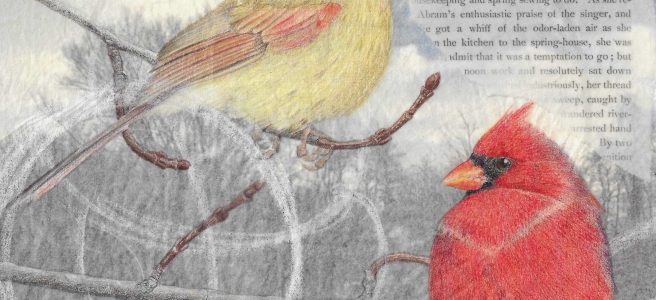
Few bird species are as iconic as the Northern Cardinal. Our love-affair with the Cardinal has a long history and has been used to help advance the goals of conservation. In 1903 Gene Stratton Porter published The Song of the Cardinal. Her plucky hero and heroine were a pair of newly mated birds keeping house at the edge of human habitat. In the book, an old farmer and his wife (Abram and Maria) become their admirers and protectors. Here I’ve included a page from the book, a moment when Maria decides to heed the Cardinal’s call to Come See! Come See!

I feel deeply emotional about It Was a Temptation, as Stratton-Porter intended with Song of the Cardinal. The deeply humanized birds at the center of her novel evoked a strong emotional response from a wide readership. Do anthropomorphic animal characters support the cause of conservation or blur the lines between human and animal needs? I don’t have an answer, but I believe we can enlarge our circle of care beyond our own families and communities when we empathize with other people and creatures.

I illustrated this piece on transparent paper, which has a different feel under my pencils than the drafting film. And when combined with the digital image underneath, it reveals and hides shapes and colors in its own way. I like the more rustic results.

It Was a Temptation is available for purchase. Contact me for more information.
Beautiful Spring Brook

There was a struggling American Plum in my mother’s front yard. It was trapped by pines, and every year it would hang low enough to scratch the top of the cars backing out of the driveway.

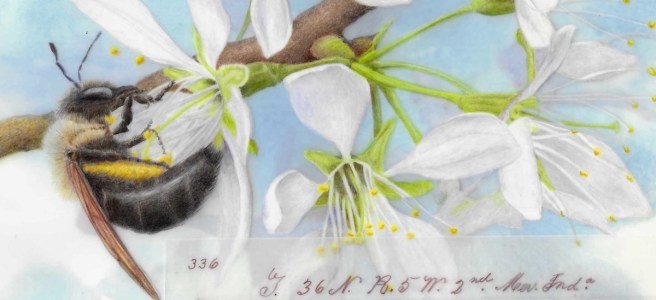
Sadly, the plum’s been removed. But in its last spring, I brought a flowering branch home to do some sketching on my patio. Within minutes, the fresh blossoms attracted a lovely mining bee, one of the earliest native Indiana bees to emerge each year. Early flowering trees like the plum provide spring bees with essential food when little else is blooming. I like to include this piece when I exhibit a collection of bird artwork because insects are a critical food source for many birds. Insects that pollinate do double work and ensure food sources for birds and wildlife.

The phrase “beautiful spring brook” is lifted from the text decorating this piece. The words are reproduced from nineteenth century Land Survey notes for Porter County Indiana. It’s rare to find a reference to beauty in these notes, which are mostly dry descriptions of the widths of trees and the locations of survey posts. But every now and then a phrase escapes the pen of the surveyor suggesting “I see this place.”

Beautiful Spring Brook is available for purchase. Contact me for more information.

Wrapping up November

It’s time to put fall to bed and prepare for winter. We’ve stored the lawn furniture and emptied the flower pots. The hoses are unhooked, the taps insulated. The garden is tidy, and the flower beds weeded. We’re ready to slow down, tuck in, and open ourselves to quieter, shorter days.

Sassafras

The leaves changed unevenly this year. Black walnut turned first, soft yellow sifting thinly to carpet the grass. The sugar maples added a brief, showy red, while silver maples clung to their green until the last moment. We spent the peak time for leaves in Brown County, Indiana, poking through shops and hiking at the state park. We came home to find a few scattered oranges among somber oaks.

Downtown from the Coffee Shop

After two decades in Colorado, enjoying fall Aspen, the color that startles me is the fluorescent peach of sassafras leaves. Even in the gloom of a winter afternoon, with the sun setting before 5 pm, the sassafras somehow gleam in the shadows. Above them, the setting sun casts pinks and lavenders against ragged clouds.

Acorn

Much more somber, the oak leaves are raining down even as they persist in the canopy. As kids, we raked those heavy leaves every fall, making giant piles for jumping into or piling over each other. The scratchy bits, and a few insects, would find their way down the backs of shirts and pants. Looking up through a blanket of brown leaves, I would watch the contrails of airplanes spreading out, white against blue. Those memories are carried back to me on the scent of warm leaves and acorns crunching underfoot.

There’s a wonderful space available in the weeks before Thanksgiving. In that space we can take a breath, take a walk, and watch the scattering leaves fall like snow.

Cicada Summer

The sound seems to drift down from the heights of the tall trees. It’s a dreamy, lazy buzzing, rising and falling in volume, and tapering off to be picked up again in a slightly different place. Growing up in Indiana, it was the background sound to the “dog days” of summer. I can’t separate my memories of freezer pops and visits to the Lake from the thrumming sound of the annual cicadas.

Our yard (3 acres of weedy grass, silver maple and black walnut) is revealing its wealth of insects this year (and other critters). Along the tree lines, I’m delighted by flying bugs, bees, spiders, and dragonflies. I discovered a tree frog sheltering from the sun, and rescued a handful of hungry monarch caterpillars that would have starved where they hatched. I moved them to bigger fare.

Gratitude seems like a small word to exchange for this bounty of wonders. I get to play out of doors as part of my job, and then generate something lovely from that play. The hours I spend outside observing, recording, watching, and listening are as important as the hours I spend in the studio creating, drawing, composing and rendering.

A new project is emerging from my summer’s work, as I process a deep dive into nature and local history. It combines my fine art paintings with genealogy and environmental education. You can follow along as I develop the project in upcoming posts.

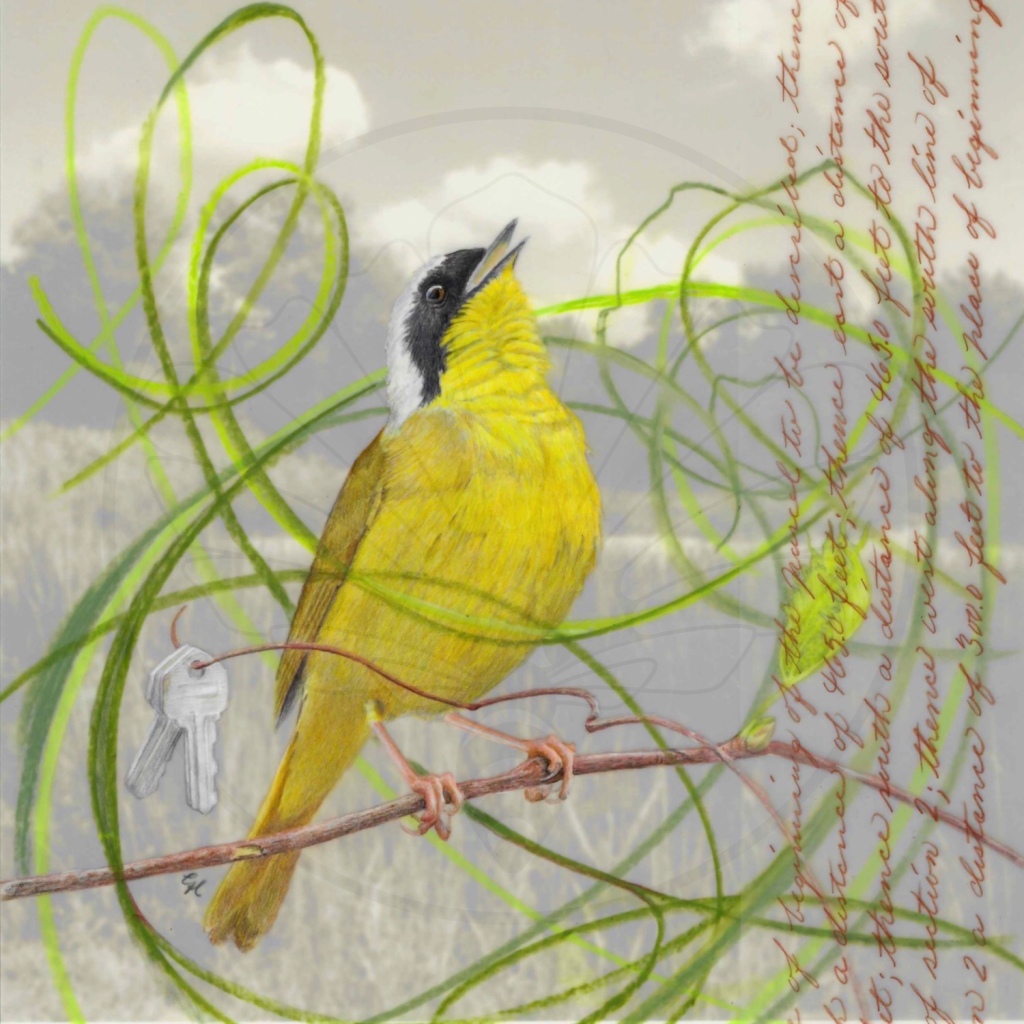
In the mean time, the first two pieces are almost complete. The first is called “Place of Beginning,” and reflects our move back to Indiana. The text is a partial legal description from our mortgage documents. This bird is emerging from chaos (have you ever moved across country?). It’s song is a clear bell coming from the storm of activity brought on by change.

Each piece in this new project will incorporate historic documents about a geographic location, feature, or region (such as the Kankakee River or the Indiana Dunes). The documents record changes in Northwest Indiana between the years of settlement (roughly 1830) to the first successes of the conservation movement in the early twentieth century (roughly 1925). I’m eagerly searching out diary entries, land survey notes, stories, poems and articles.

“Enter a Wet Prairie” explores the historic loss of habitat for grassland birds like the Dickcissel. The background photo is the restored prairie at Reynolds Creek Game Bird Area, and the historical document is the land survey note matching that location. Restoration efforts in Porter County are reclaiming land for tallgrass prairie, and there is hope that we can continue to enjoy grassland plants and animals into the future.

Thanks for making it to the end!. As a reward, please claim your free downloadable prairie kaleidoscope coloring page!

Drama in the Dunes

Recently, my friend Kristina and I met at the Great Marsh Trail in the Indiana Dunes National Park for nature journaling. I expected sunshine, mosquitos, lots of birds, and overgrown trails. I didn’t expect small dramas to unfold as we worked. Nature is teaching me to pay more attention.
It can be hard to settle down to observing and sketching. It turns out you can’t bird, and photograph, and sketch all the same time! And then you want a better look at a swallow, or are distracted by sandhill cranes honking in the distance. Somehow we managed to settle in. A cooperative Common Yellowthroat returned several times to sing from a favorite perch. Kristina captured his confident posture and made a beautiful sketch of his surroundings (see her wonderful avifauna paintings at KristinaKnowski.com)

Capturing a Common Yellowthroat in action. Copyright Kristina Knowski.

I had a long look at Canada Geese through my binoculars and enjoyed sketching them. They were rolling their heads at one another, and I wondered what they were communicating.

Birds are constantly in motion. Copyright Christine Hubbell.

Clouds moved in and the wind picked up. We headed east, hoping to find a viewpoint into the next marsh and maybe a peek at the cranes. We passed a turtle and a frog on the trail. What did they think of each other?

A storybook encounter? This Northern Leopard Frog seemed to be making the same journey as the turtle.

On our way out Kristina noticed a noisy confrontation unfolding just off the road. A variety of bird species were agitated, but it was the Oriole making the most racket. He was harassing a pair of red-shouldered hawks. I saw the female come in once, and we spotted a feisty robin approach, but otherwise the Oriole was on his own. We didn’t stay to see who won, but I left with loads of questions.

A dramatic encounter recreated from memory and photos, enriched by curiosity. Copyright Christine Hubbell.

Observation opens our curiosity in ways that can only be satisfied with more observation. Were the frog and turtle “together” on the trail? Or were they coincidentally moving from the wet marsh to drier land? Maybe we happened on a favored crossing zone. Had the hawks eaten recently? (They seemed disinterested in the kerfuffle they were creating.) How often do the hawks visit that spot?

Unanswered questions, excellent company, and a beautiful day are now woven into the pages of my journal, and I’m grateful for the ability to be aware and present in nature. I’m sure I’ll enjoy this rich set of memories during the darker and quieter days of winter.

Sand in My Shoes and a Song in My Heart

Memories surface like waves. The roar of the water on a windy day. The cool air juxtaposed against the heat of the sun on my skin. Sand pouring into the back of my shoes as I slide down a steep dune. I’ve been playing at the beaches along Lake Michigan’s shores since before I could walk. Many decades later, my joints are a bit stiff, and my skin is a little loose, but when I’m perched on a dune looking at the water, I feel young.

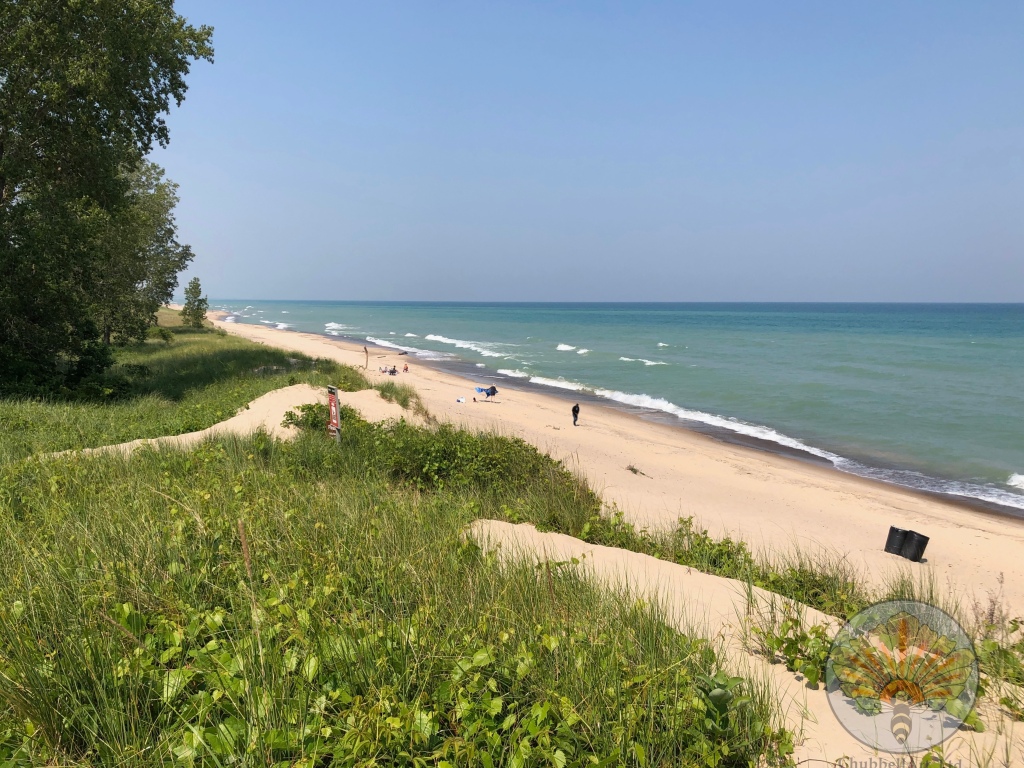
Photograph of sandy dunes sloping down to blue water at Dunbar Beach, Indiana Dunes National Park.
Brisk waves batter the shore. I can’t hear anything over the wind.

“Find a comfortable seat” is a basic guideline of nature journaling. This includes finding a comfortable place to sit or stand for the duration of sketching, and also taking good care of myself outdoors. No matter how long I plan to be out, I assume I’m doing a pack in/pack out day camp, complete with water, snacks, safety, and other comfort items. Sunscreen, bug spray, and for me, poison ivy wipes, are essential.

Photograph of artist sketching in the dunes. Close up of face.
Getting comfortable in the sand. Too windy for my big-brimmed hat!

After that, I let the rules drop away and enjoy myself. I have no idea what I’ll find to look at, and that’s part of the fun. Sometimes nothing grabs my interest, and I stare over the top of my sketchbook. It’s okay to be in the moment.

Blurry photo of dunes with sketchbook in the foreground demonstrating a nature journal entry.
Recording what I observe cements the experience in my memory. It’ll be fun to revisit this page during the dark days of winter.

I’ve taken the advice of a number of journal enthusiasts to start my page with a location map or landscape. On this trip, I loved the way the dune bluffs scalloped away from the water into the distance. I didn’t quite capture it, so I’m looking forward to going back. The nice thing about a landscape is that you can usually return more than once.

A Dune Tiger Beetle, genus Cicindela, on the hunt.

Another technique I’ve learned is to let my attention be drawn back from a distance to my immediate surroundings. That’s how I noticed one beetle chasing a much smaller beetle across the sand. Lunch!

George Fred Keck’s House of Tomorrow, moved to Beverly Shores from the Chicago World’s Fair. There are five Century of Progress homes. The other four have been leased to tenants who have restored their interiors. This home is currently being remodeled.

Dunbar Beach in Beverly Shores is now part of the Indiana Dunes National Park. But when I was growing up, the Century of Progress homes, the narrow sunlit beach, and the bend in the road at Kemil Beach were the nameless landmarks of our endless childhood summers. I love being back.

Things get a little sandy at the beach.

The Creative Season

For me, March is the opening of the creative season. As the studio fills with new ideas, the world pivots from darkness to light, from the quiet waiting of Winter to full-throated Spring. It’s a good time for reflection. My artwork continues to evolve, but with familiar components—a love of beauty, a prayer for conservation, a hope of connection.

Eastern Bluebirds in progress, on a cake plate with peach and lottery ticket. Colored pencil on drafting film.

My recent colored pencil paintings capture imaginary wildlife encounters in human spaces, blending storytelling with natural science illustration. They place birds in human-made settings, echoing the role we play in shaping and controlling wildlife habitat. I’m never sure where the whimsy comes from, but I need that playfulness to round out my compositions.

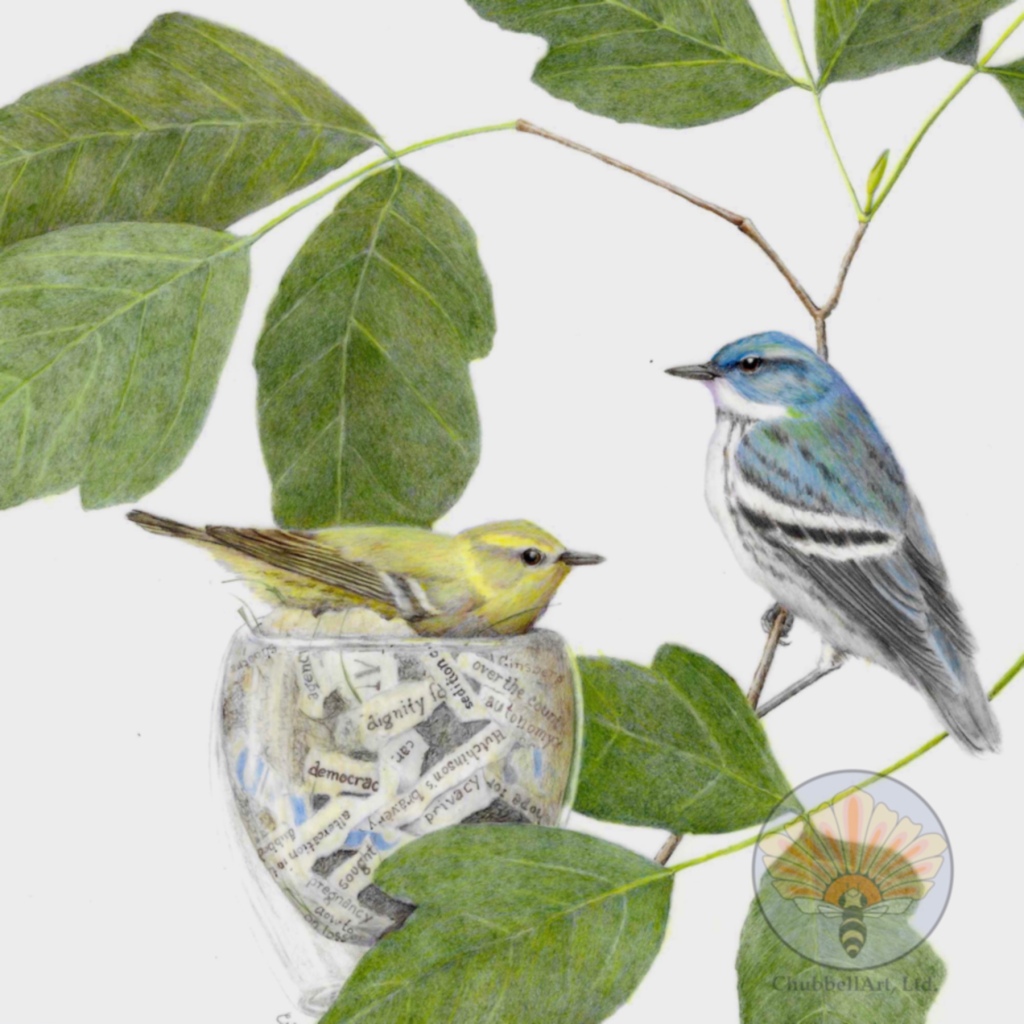
I created “Folly” in response to seeing nesting Cerulean Warblers at a birding festival. Through the scope, we watched the male and female tending their nest, tucked in the crook of a branch about 20 feet directly above a busy trail. It reminded me that birds have a precarious life, often struggling to succeed in challenging conditions.

“Folly.” Colored pencil on drafting film. Selected for the Hoosier Women Artists Exhibition 2023, it’s on display for a year at the Indiana State House.

I illustrated the nest as a glass cup filled with the news of the day, a fragile and potentially disastrous choice. I surrounded them with Poison Ivy, which has a dual nature. It’s terrible for us, but beneficial for birds. I titled this piece “Folly” because foolishness is a good place to begin any journey. In foolishness we find the confidence to trust we’ll find what we need along the way.

I don’t know where my muse is taking me this year, but if it’s a Fool’s Journey, it’s bound to be interesting.

Little Mice, Making Mischief

At 3 a.m. we awoke with a start to the sound of mayhem coming from the kitchen. My husband arrived first on the scene, and was just in time to see our otherwise lazy cat flying along the counter-top in hot pursuit of a mouse.

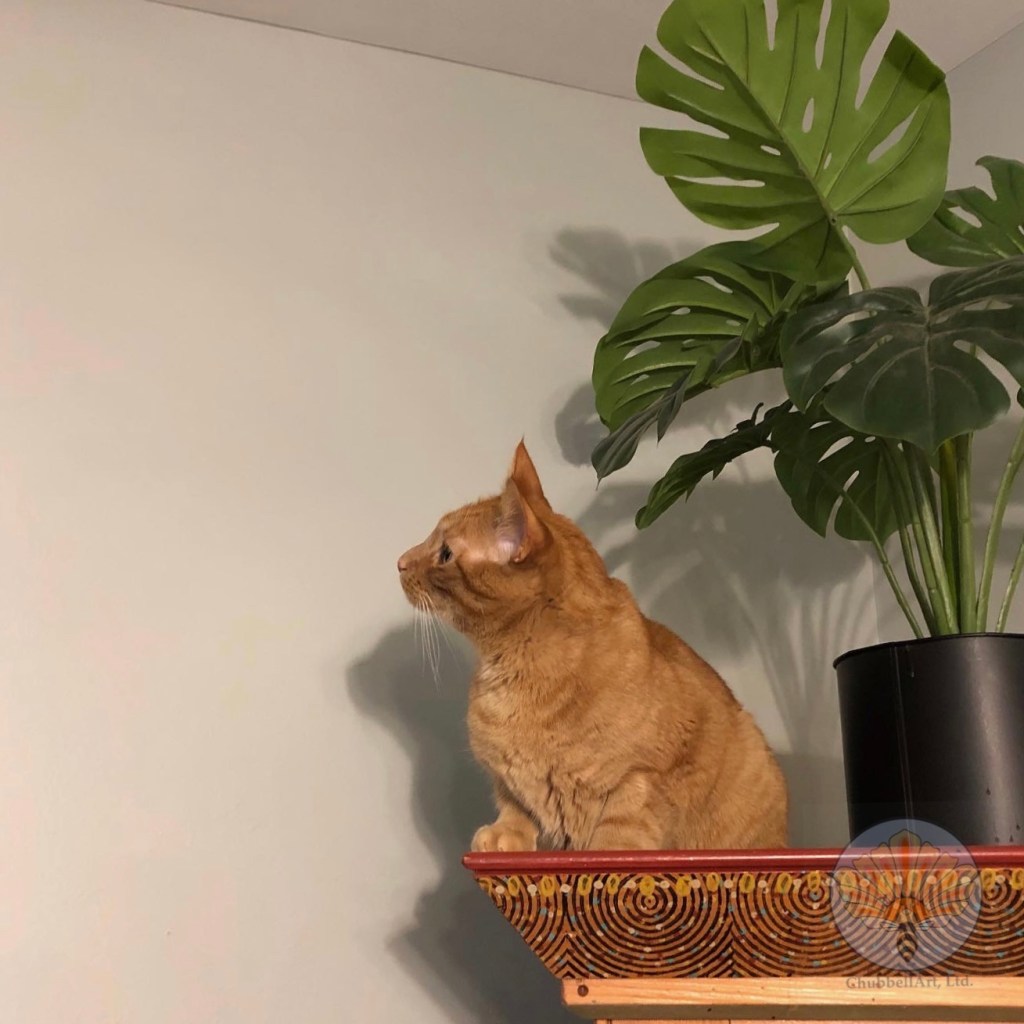
Listening for mice in the walls, or maybe just thinking about shadow puppets.

The plural noun for a group of mice is a “mischief.” How appropriate for the mice that share our home. They’ve eaten my favorite rubber spoons, left trails of droppings behind the stove, and shredded a pair of oven mitts for nesting material (eek!). But at least the cat finally got some exercise.

By the time I got to the kitchen the excitement was over. We set some live traps, did our best to decontaminate the scene, and eventually flopped back into bed. I don’t think we slept much. I kept listening for the trap in the kitchen to spring, too far away to hear except in my imagination.

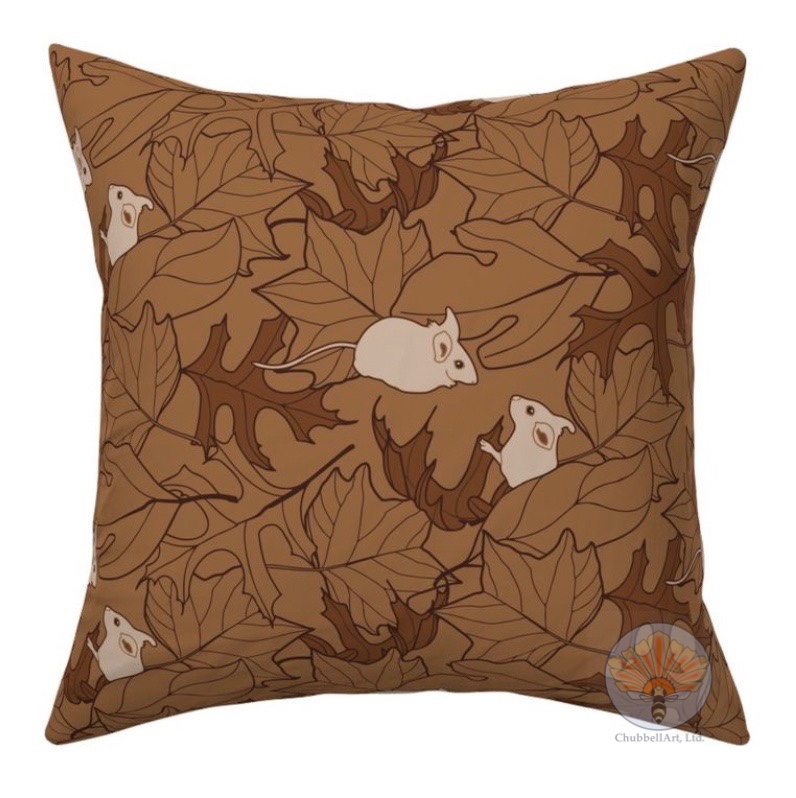
The experience rattled around in my brain for a few months before a Spoonflower neutral pillow contest brought it to the surface. We caught two mice in our live traps, and I released them among the leaves and grasses. Now they’re hanging around in this repeating pattern, no doubt hoping to find my new oven mitts or a tasty spoon.

Would you like to explore with the mice? You can purchase this design on Spoonflower soon, or sign up for my e-newsletter for special info and a free coloring page.

Year of the (Bunny) Rabbit

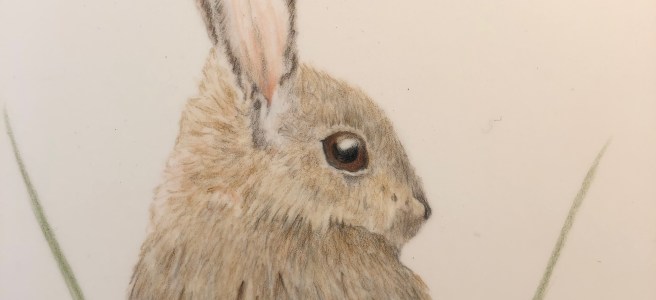
Baby bunnies are all ears and bellies. To celebrate the Year of the Rabbit, I’ve just completed three eastern cottontail illustrations based on my photos. May is a reliable time to watch for these tiny foragers, who will taste almost everything in the garden. We were entertained by their zippiness, which I suppose kept them from being taken by hawks and owls. We weren’t so fond of their appetites. They especially loved my Firewitch Dianthus, and I hardly got to see it bloom once the bunnies arrived. I’ve illustrated them with phlox, another of their favorites. Which bunny would you choose?

Baby bunny illustrations

Originals and prints will be available soon. Please use the contact page if you’re interested.

There is Delight in Strangeness

It’s late afternoon in the studio. Soft light sifts through the branches of the maple tree, and I’m longing to explore the spring plants emerging along the hedgerow. After two decades as happy Coloradans, we’ve returned to the Midwest to be Hoosiers. We’ve got a little more breathing room, a lot more yard, and a new home for ChubbellArt.

In February, my husband and I loaded our cats into their fancy carrier for the cross-country trek from Colorado to Indiana. It’s been almost two decades since we drove west with a different pair of cats to new jobs and new adventures on mountain trails. Now we were returning to our roots and to family, following the Platte River east as flocks of sandhill cranes descended on the Nebraska corn fields.

Exploring the Air BnB

If the cats noticed the cranes, they kept it to themselves. It was bitterly cold, in the single digits with plenty of sunshine. After a few hours of restless complaining, they settled into a routine of occasional medicated mewling. We reached Lincoln after dark, grateful for GPS navigation and a warm Air BnB. We let go of the chaotic violence of loading day, the memories already softening into story.

Moving-in Day

When the moving van arrived at the end of our driveway, a flock of Sandhill Cranes flew over the house. I took it as a benediction. Soon, the moving-in crew was hustling every box, tote, and stick of furniture inside. There was chaos, lots of cleaning up, and exhaustion on all sides. I’m grateful for the few days we had between moving out and moving in—days to quietly observe nuthatches cascading down the trunks of the maple trees, and to listen to the small flock of redwing blackbirds singing in the cattails across the road.

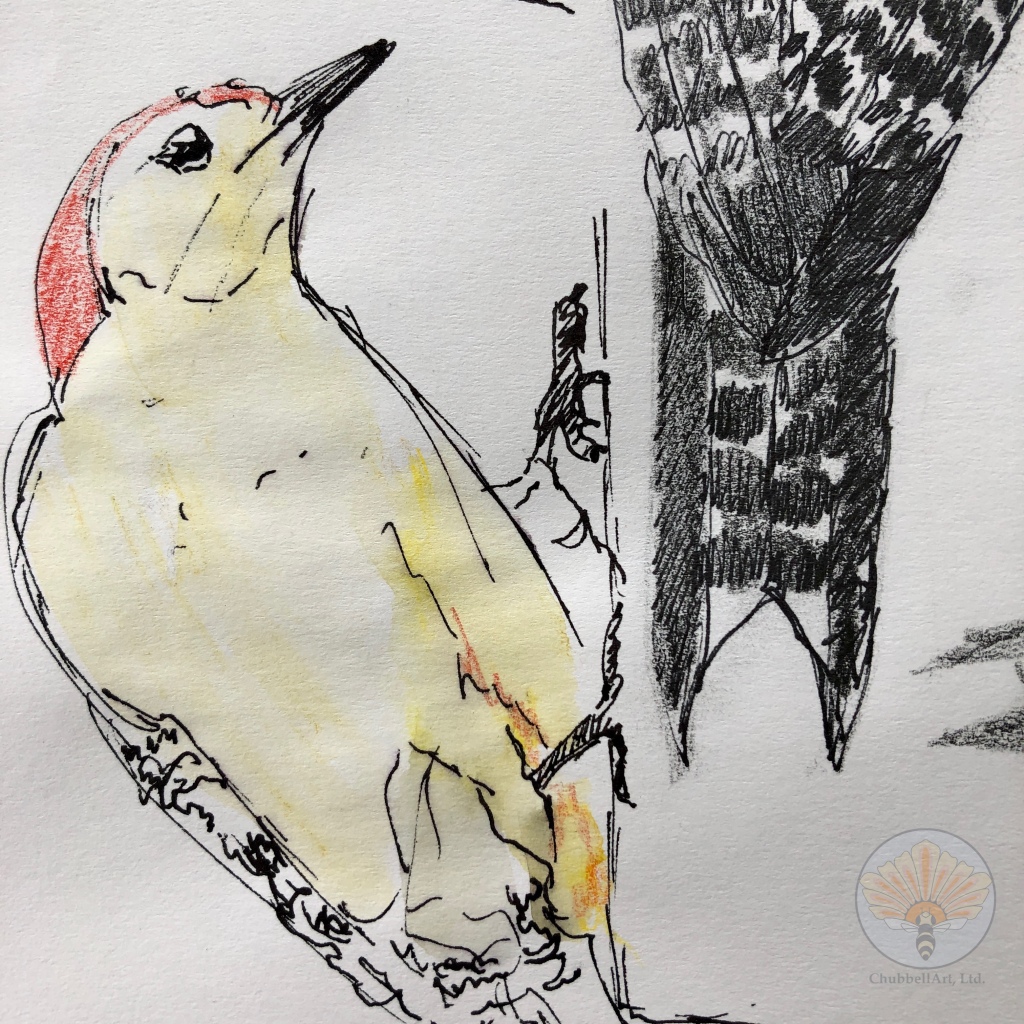
A resident Red-bellied Woodpecker

Two months after unpacking the last box, my husband and I are slowly settling into new rhythms. And though it still feels like we’re between leaving and arriving, I take joy in the birds vying for the suet feeders. We stroll on the beach, visit family, and make home repair appointments. Meawhile the cats patrol endlessly round and round the rooms, remarking the furniture. Sometimes they circle back to us in recognition that our little family is all that really matters. But mostly they complain about the increase of clouds and the lack of window ledges.

Lake Michigan at Indiana Dunes State Park

Soon enough, this unsettled feeling will be replaced with the more grounded sense of being at home, so I want to slow down and savor the strangeness, too. We’re constantly delighted by some new surprise. Hiding among the non-native trees and shrubs we’re finding walnut, oak, black cherry, and raspberry. Woodpeckers, migrating warblers and grosbeaks are flitting through, providing lots of challenging inspiration for art. This leg of our life’s adventure is as open to possibility as the previous twenty years, and I can’t wait to see what comes next.