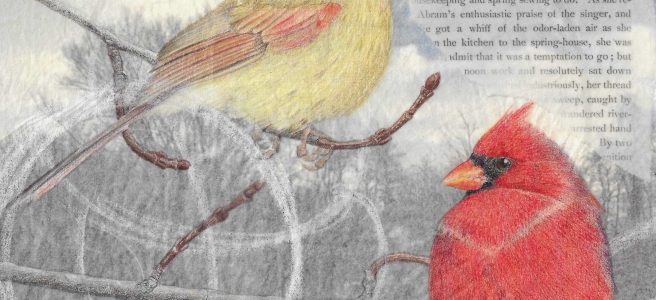
Few bird species are as iconic as the Northern Cardinal. Our love-affair with the Cardinal has a long history and has been used to help advance the goals of conservation. In 1903 Gene Stratton Porter published The Song of the Cardinal. Her plucky hero and heroine were a pair of newly mated birds keeping house at the edge of human habitat. In the book, an old farmer and his wife (Abram and Maria) become their admirers and protectors. Here I’ve included a page from the book, a moment when Maria decides to heed the Cardinal’s call to Come See! Come See!
I feel deeply emotional about It Was a Temptation, as Stratton-Porter intended with Song of the Cardinal. The deeply humanized birds at the center of her novel evoked a strong emotional response from a wide readership. Do anthropomorphic animal characters support the cause of conservation or blur the lines between human and animal needs? I don’t have an answer, but I believe we can enlarge our circle of care beyond our own families and communities when we empathize with other people and creatures.
I illustrated this piece on transparent paper, which has a different feel under my pencils than the drafting film. And when combined with the digital image underneath, it reveals and hides shapes and colors in its own way. I like the more rustic results.
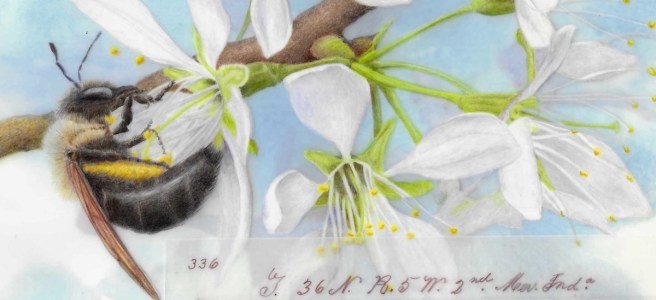
There was a struggling American Plum in my mother’s front yard. It was trapped by pines, and every year it would hang low enough to scratch the top of the cars backing out of the driveway.
Sadly, the plum’s been removed. But in its last spring, I brought a flowering branch home to do some sketching on my patio. Within minutes, the fresh blossoms attracted a lovely mining bee, one of the earliest native Indiana bees to emerge each year. Early flowering trees like the plum provide spring bees with essential food when little else is blooming. I like to include this piece when I exhibit a collection of bird artwork because insects are a critical food source for many birds. Insects that pollinate do double work and ensure food sources for birds and wildlife.
The phrase “beautiful spring brook” is lifted from the text decorating this piece. The words are reproduced from nineteenth century Land Survey notes for Porter County Indiana. It’s rare to find a reference to beauty in these notes, which are mostly dry descriptions of the widths of trees and the locations of survey posts. But every now and then a phrase escapes the pen of the surveyor suggesting “I see this place.”
It’s time to put fall to bed and prepare for winter. We’ve stored the lawn furniture and emptied the flower pots. The hoses are unhooked, the taps insulated. The garden is tidy, and the flower beds weeded. We’re ready to slow down, tuck in, and open ourselves to quieter, shorter days.
Sassafras
The leaves changed unevenly this year. Black walnut turned first, soft yellow sifting thinly to carpet the grass. The sugar maples added a brief, showy red, while silver maples clung to their green until the last moment. We spent the peak time for leaves in Brown County, Indiana, poking through shops and hiking at the state park. We came home to find a few scattered oranges among somber oaks.
Downtown from the Coffee Shop
After two decades in Colorado, enjoying fall Aspen, the color that startles me is the fluorescent peach of sassafras leaves. Even in the gloom of a winter afternoon, with the sun setting before 5 pm, the sassafras somehow gleam in the shadows. Above them, the setting sun casts pinks and lavenders against ragged clouds.
Acorn
Much more somber, the oak leaves are raining down even as they persist in the canopy. As kids, we raked those heavy leaves every fall, making giant piles for jumping into or piling over each other. The scratchy bits, and a few insects, would find their way down the backs of shirts and pants. Looking up through a blanket of brown leaves, I would watch the contrails of airplanes spreading out, white against blue. Those memories are carried back to me on the scent of warm leaves and acorns crunching underfoot.
There’s a wonderful space available in the weeks before Thanksgiving. In that space we can take a breath, take a walk, and watch the scattering leaves fall like snow.
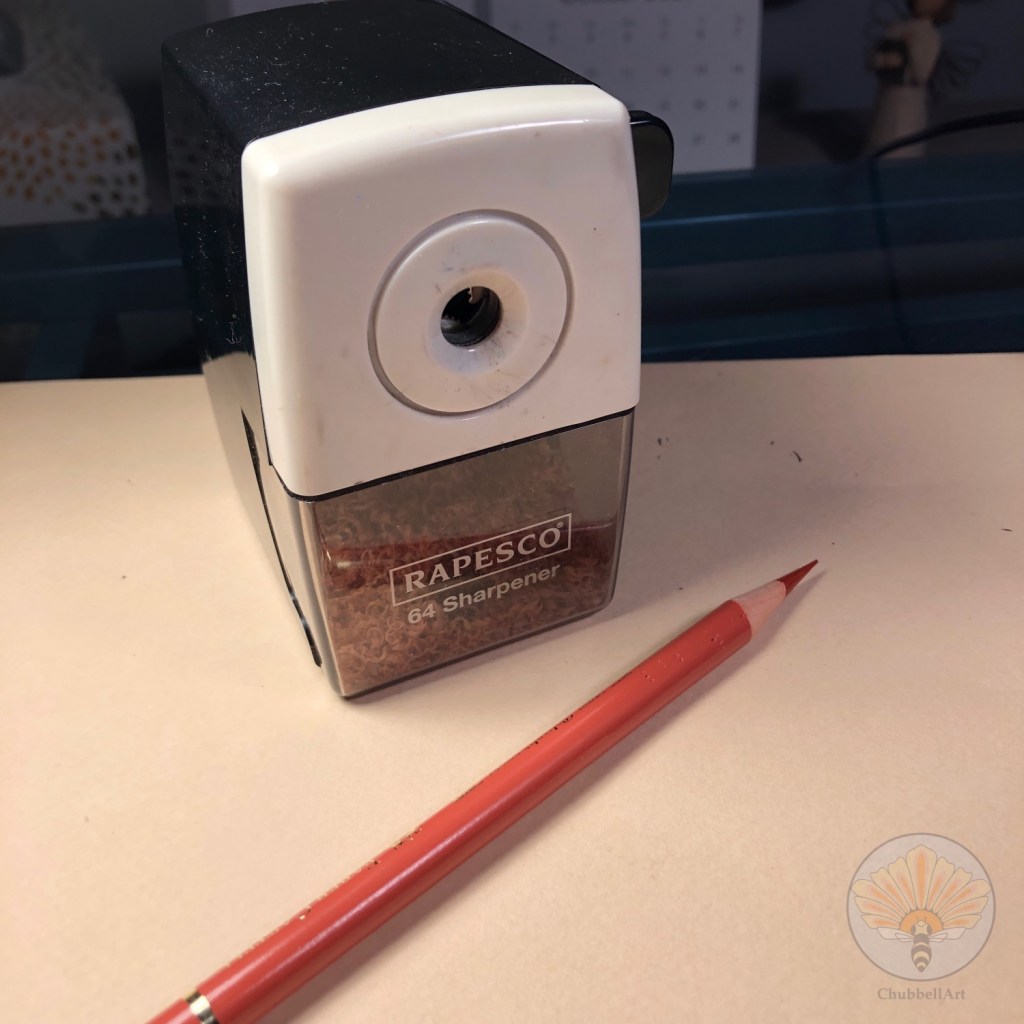
Today I’m posting a short video for my colored pencil class. We’ve been having fun with small botanicals and geeking out over pencil sharpeners. I love to see people in the zone with their artwork, so rather than interrupt them with a two-hour demo, I compressed the process into a three-minute time-lapse. Whew!
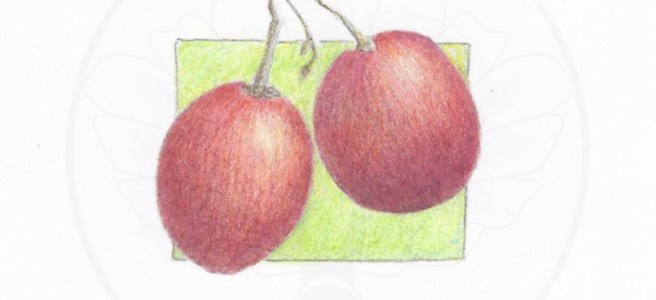
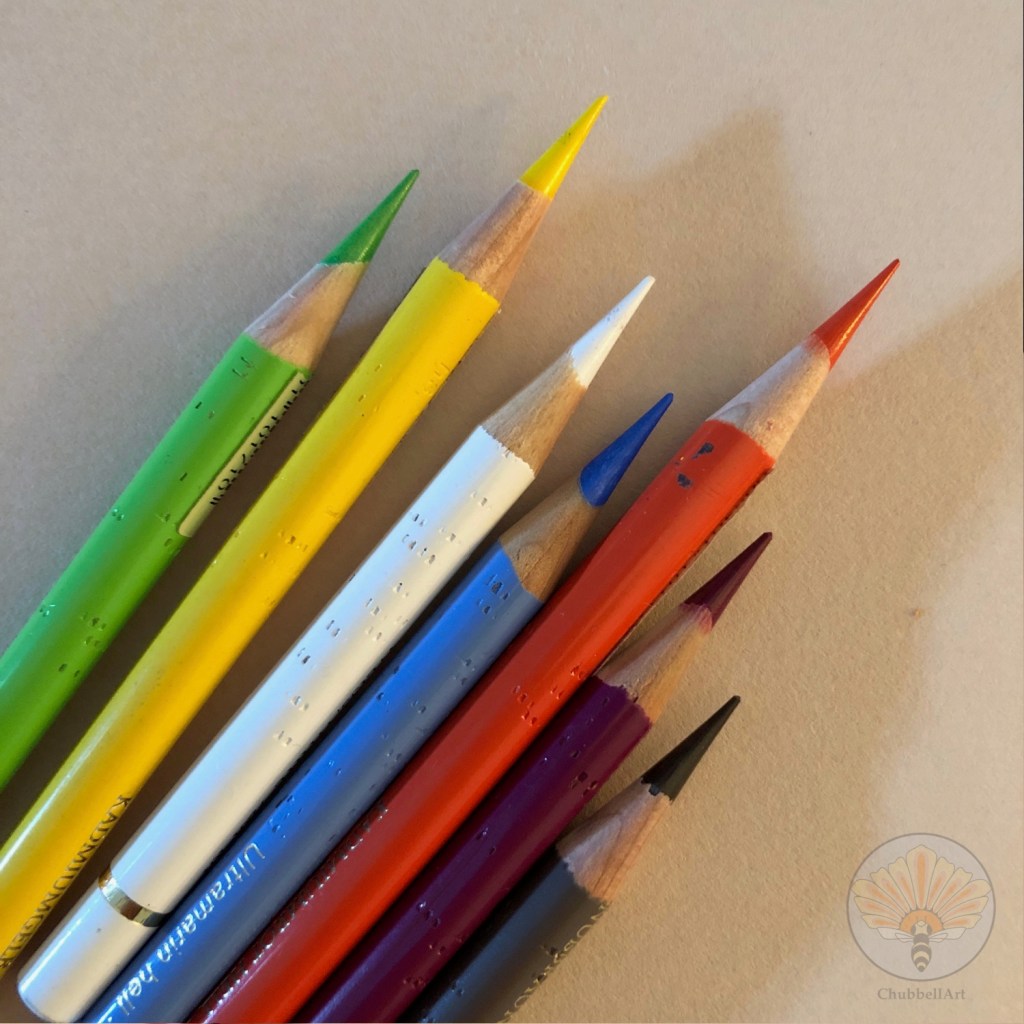
For my grapes, I chose seven colors that often show up in 12-pencil sets: white, yellow, purple, brown, red, light blue, and light green. (For my fellow pencil geeks, I’m using Faber Castell Polychromos White 101, Cad Yellow 107, Magenta 133, Walnut Brown 177, Light Cad Red 115, Light Ultramarine 140, and Light Green 171.)
Grapes are easy to draw and fun to paint. This is your invitation to head over to the fruit bowl, bring some grapes to your sketchbook, and paint along. Oh – and sharpen those pencils to a long point!
The sound seems to drift down from the heights of the tall trees. It’s a dreamy, lazy buzzing, rising and falling in volume, and tapering off to be picked up again in a slightly different place. Growing up in Indiana, it was the background sound to the “dog days” of summer. I can’t separate my memories of freezer pops and visits to the Lake from the thrumming sound of the annual cicadas.
Our yard (3 acres of weedy grass, silver maple and black walnut) is revealing its wealth of insects this year (and other critters). Along the tree lines, I’m delighted by flying bugs, bees, spiders, and dragonflies. I discovered a tree frog sheltering from the sun, and rescued a handful of hungry monarch caterpillars that would have starved where they hatched. I moved them to bigger fare.
Gratitude seems like a small word to exchange for this bounty of wonders. I get to play out of doors as part of my job, and then generate something lovely from that play. The hours I spend outside observing, recording, watching, and listening are as important as the hours I spend in the studio creating, drawing, composing and rendering.
A new project is emerging from my summer’s work, as I process a deep dive into nature and local history. It combines my fine art paintings with genealogy and environmental education. You can follow along as I develop the project in upcoming posts.
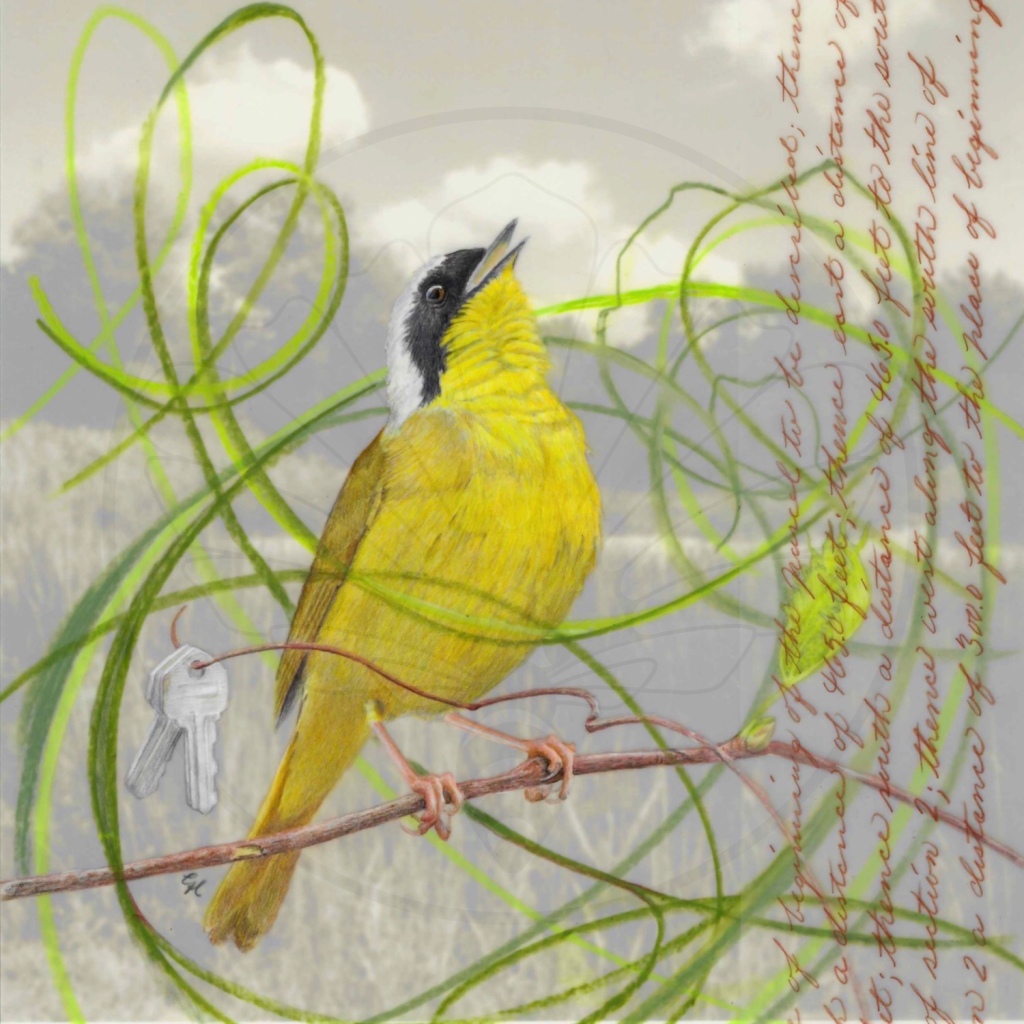
In the mean time, the first two pieces are almost complete. The first is called “Place of Beginning,” and reflects our move back to Indiana. The text is a partial legal description from our mortgage documents. This bird is emerging from chaos (have you ever moved across country?). It’s song is a clear bell coming from the storm of activity brought on by change.
Each piece in this new project will incorporate historic documents about a geographic location, feature, or region (such as the Kankakee River or the Indiana Dunes). The documents record changes in Northwest Indiana between the years of settlement (roughly 1830) to the first successes of the conservation movement in the early twentieth century (roughly 1925). I’m eagerly searching out diary entries, land survey notes, stories, poems and articles.
“Enter a Wet Prairie” explores the historic loss of habitat for grassland birds like the Dickcissel. The background photo is the restored prairie at Reynolds Creek Game Bird Area, and the historical document is the land survey note matching that location. Restoration efforts in Porter County are reclaiming land for tallgrass prairie, and there is hope that we can continue to enjoy grassland plants and animals into the future.
For me, March is the opening of the creative season. As the studio fills with new ideas, the world pivots from darkness to light, from the quiet waiting of Winter to full-throated Spring. It’s a good time for reflection. My artwork continues to evolve, but with familiar components—a love of beauty, a prayer for conservation, a hope of connection.
Eastern Bluebirds in progress, on a cake plate with peach and lottery ticket. Colored pencil on drafting film.
My recent colored pencil paintings capture imaginary wildlife encounters in human spaces, blending storytelling with natural science illustration. They place birds in human-made settings, echoing the role we play in shaping and controlling wildlife habitat. I’m never sure where the whimsy comes from, but I need that playfulness to round out my compositions.
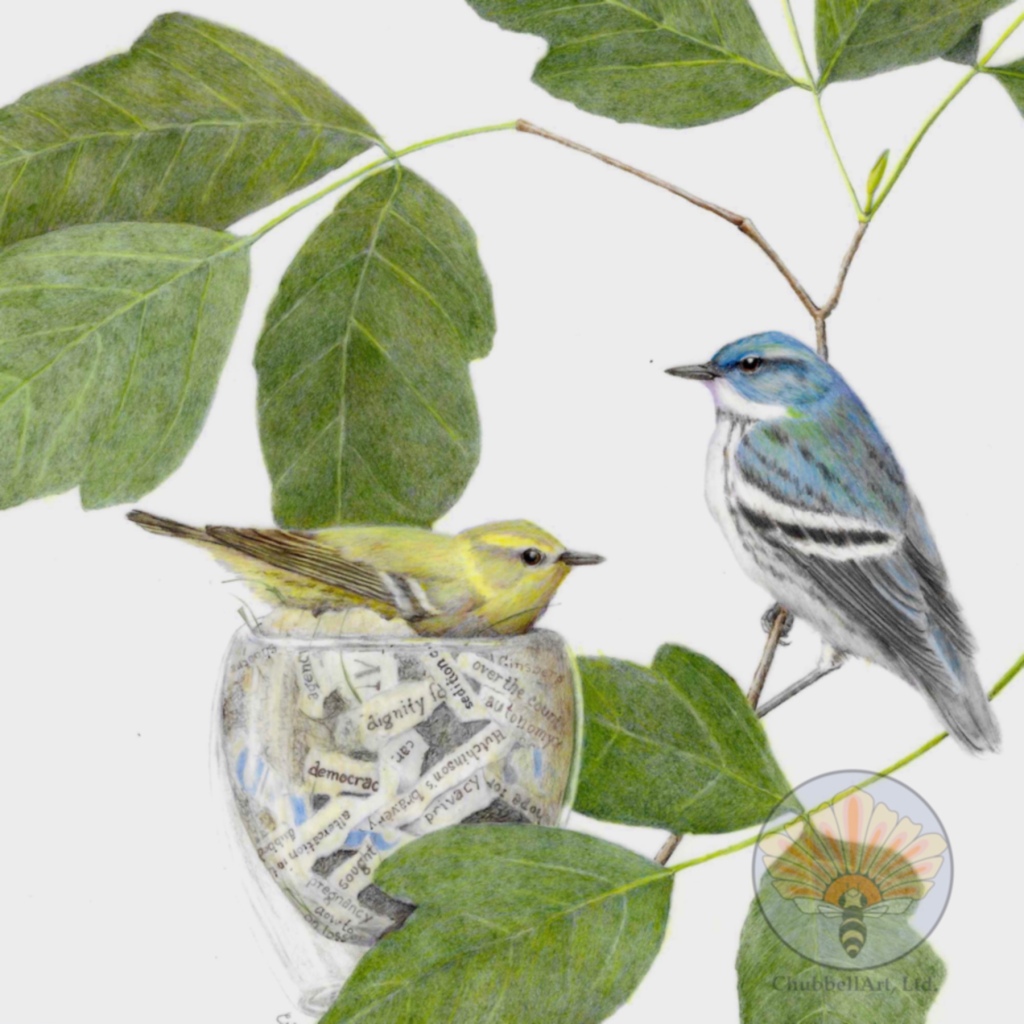
I created “Folly” in response to seeing nesting Cerulean Warblers at a birding festival. Through the scope, we watched the male and female tending their nest, tucked in the crook of a branch about 20 feet directly above a busy trail. It reminded me that birds have a precarious life, often struggling to succeed in challenging conditions.
“Folly.” Colored pencil on drafting film. Selected for the Hoosier Women Artists Exhibition 2023, it’s on display for a year at the Indiana State House.
I illustrated the nest as a glass cup filled with the news of the day, a fragile and potentially disastrous choice. I surrounded them with Poison Ivy, which has a dual nature. It’s terrible for us, but beneficial for birds. I titled this piece “Folly” because foolishness is a good place to begin any journey. In foolishness we find the confidence to trust we’ll find what we need along the way.
I don’t know where my muse is taking me this year, but if it’s a Fool’s Journey, it’s bound to be interesting.
Baby bunnies are all ears and bellies. To celebrate the Year of the Rabbit, I’ve just completed three eastern cottontail illustrations based on my photos. May is a reliable time to watch for these tiny foragers, who will taste almost everything in the garden. We were entertained by their zippiness, which I suppose kept them from being taken by hawks and owls. We weren’t so fond of their appetites. They especially loved my Firewitch Dianthus, and I hardly got to see it bloom once the bunnies arrived. I’ve illustrated them with phlox, another of their favorites. Which bunny would you choose?
Baby bunny illustrations
Originals and prints will be available soon. Please use the contact page if you’re interested.
We just had a cold snap here in Colorado Springs, with night-time temperatures dipping below 40. Mornings have a crisp chill that makes it hard to get out of bed, and spots of gold and russet signal the beginning of Autumn. Nature is pointing us toward a quieter cycle, and a last chance to sketch deciduous trees before they drop their leaves for winter. It’s the perfect time to share some quick tips for sketching trees.
Copyright 2021 ChubbellArt, Ltd.
Cottonwoods and Mountain Ash, American Plum, Gambel Oak and Willow, and even the little Common Hoptree sapling in our yard will be putting on fall color soon. So while the days continue to warm into the 70s and low 80s, I get my kit and head down to the park.
Copyright 2021 ChubbellArt, Ltd.
I remember the first advice I got about sketching trees: “Don’t draw lollypop trees.” “Don’t try to draw every leaf.” That leaves (ha ha!) quite a bit of room for the unknown! So let’s back up a step to prepare for sketching by looking intentionally at different aspects of trees.
Sit far enough from the tree to see all of it without straining. Copyright 2021 ChubbellArt, Ltd.
Start by finding a comfortable seat far enough from the tree so you can see all of it without moving your head. By asking productive questions, you can break the tree apart to understand it, then put all the pieces back together in a coherent way. Here are some questions to get you started:
Can you pick one shape that represents the tree? Maybe it’s a diamond or a cone, a sphere or even a cube. The shape of the tree may be typical for its species.
Is the tree in direct sunlight or shade? How do the shadows create the three-dimensional form of the tree? How might they change in the next 15 minutes? The next hour?
How does the tree grow? Working from the roots and trunk upward, how do the main branches divide from the trunk, and what are those branches like? How many branches can you see peeking through the leaves or needles? Is the trunk single or double? Is it straight, gnarled, split?
What shapes do the leaves or needles make as they form clumps along the branches? Cones? Cubes? Spheres? Can you see individual leaves? What shapes are the leaves? Leaf shape is also a way to identify a tree species, so you might want to sketch the leaves separately.
What’s unique about this tree? Are there interesting bits of sky visible between leaves or branches? Does the tree have a cavity or a nest?
What do you love about the tree? Something drew you to this spot. What was it?
You can start to record your observations at any point, just know that you’ll want to make adjustments while you work. Start with a light touch in pencil or pen, then reinforce the lines as you work. I like to create an “envelope” based on the ratio of the tree’s height to width. I draw the envelope first, then cut in the overall shape of the tree. Inside the shape, I place the landmarks I’ve observed. These landmarks are essential for getting the details in the right places. There’s a time-lapse video at the end of this post that shows my process.
Branches are a lovely subject for studying negative space. Copyright 2021 ChubbellArt, Ltd.
Deciduous trees offer us that last beautiful gasp of color before they drop their leaves in the fall. The golds and yellows we get here in Colorado won’t peak for another week or two. But I know that bare branches are just around the corner, and just as fun to sketch!
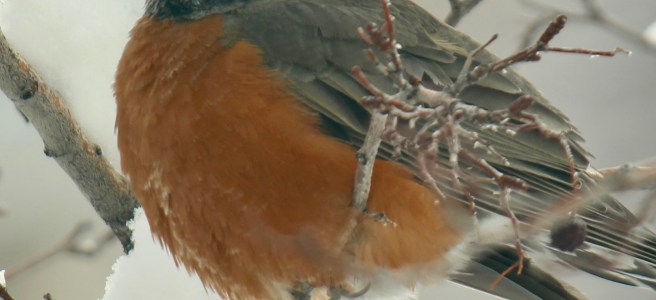
When the weather was too poor this winter for outdoor sketching, I set up my drawing supplies on the porch, plugged in the space heater, and worked on sketching birds from life. I found the chickadees and finches very challenging. Why couldn’t I observe some sleeping ducks on a pond instead? But the most convenient, numerous collection of live birds was right there on the other side of my window.
February feeder birds sketches, mostly Juncos and House Finches.
So I worked, and struggled, and wondered how anyone completes an actual sketch of a bird in the field. I started with basic gestures, borrowing ideas from books, blogs, and videos. I knew I could draw from photos, but I wanted to be able to complete a finished-looking sketch during my sketching session. Then I found a bit of helpful advice: build your memory.
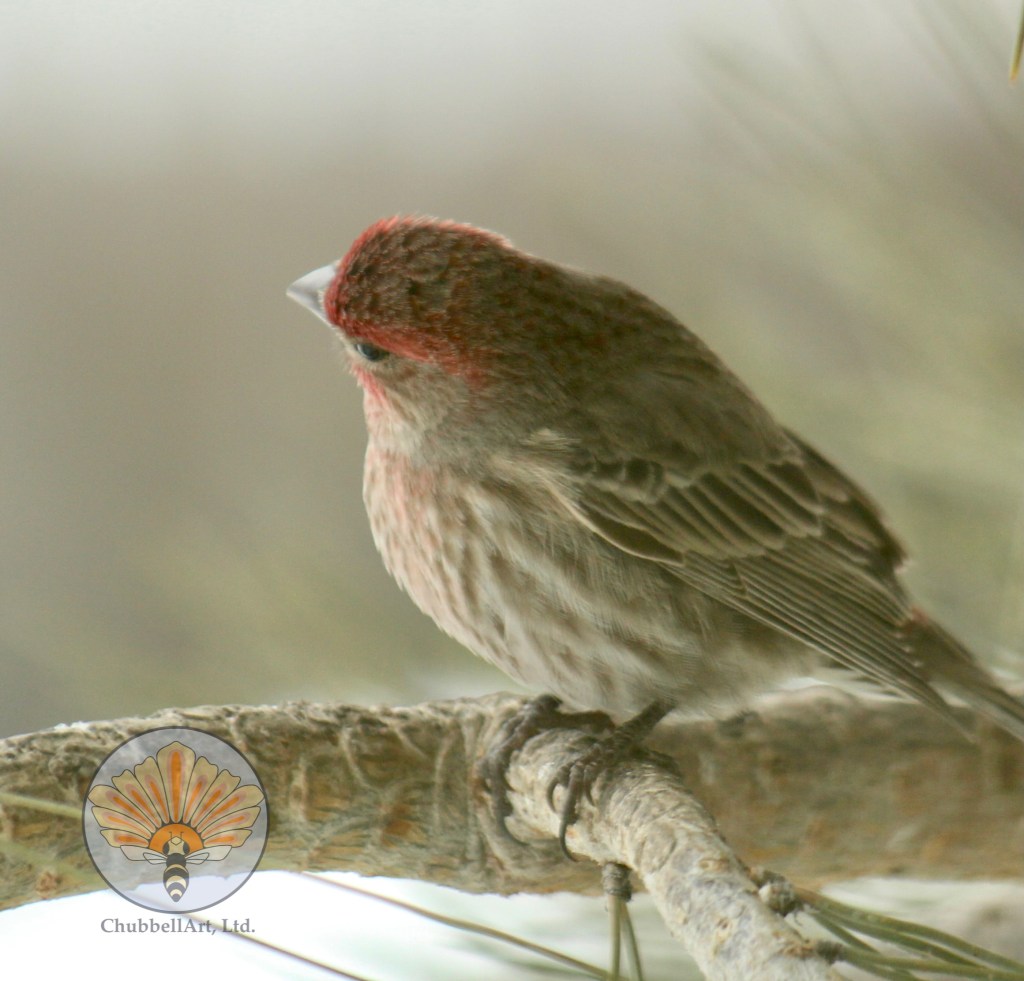
Always on the lookout, and constantly on the move: House Finch in the Ponderosa Pine. You only get a moment to capture something about a live bird.
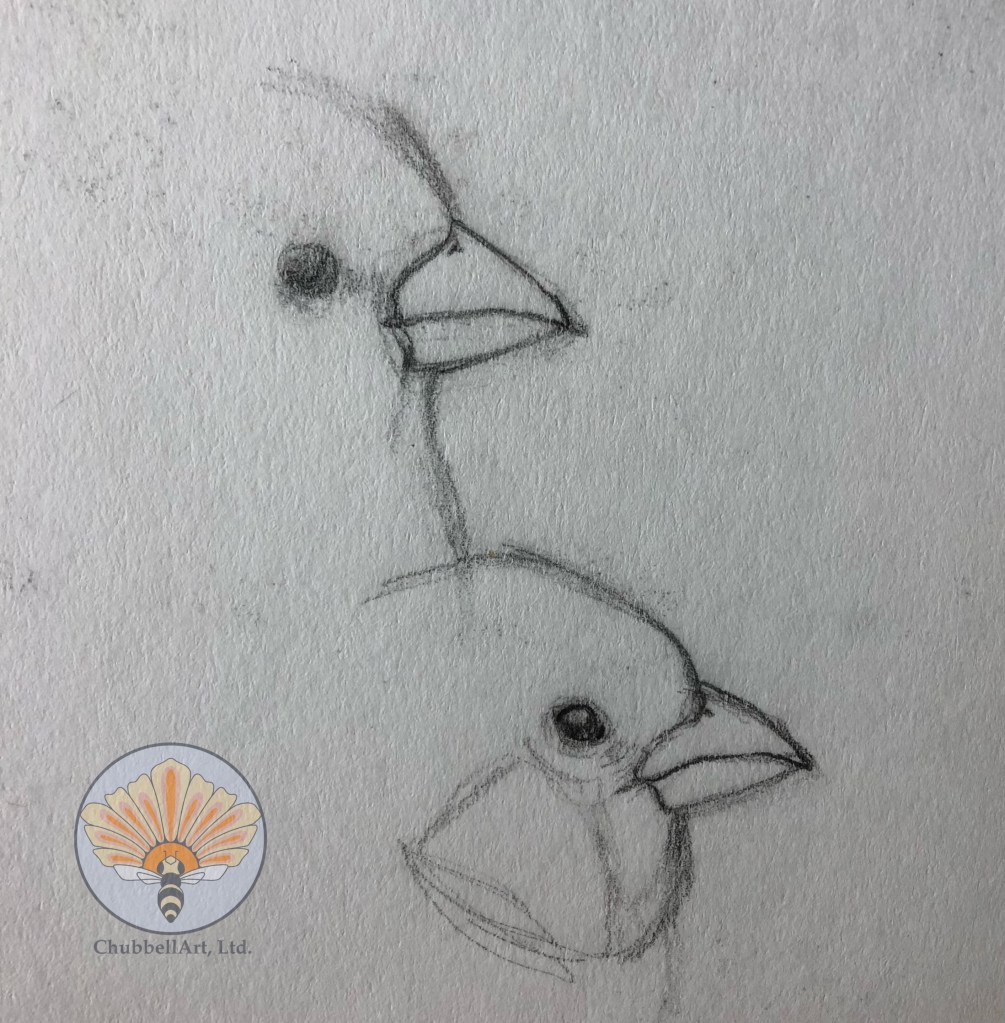
Hmmm, I thought. I guess I should memorize the shape of that finch bill. But no, it’s not like school. I couldn’t memorize a set of visual facts. Putting the right information into memory requires repeated drawing from life, which enhances both my observation and drawing skills.
The more we look, the better we understand. A second observation of a House Finch bill at bottom right.
When I realized that the practice itself would build my memory and make sketching faster, I stopped struggling. Drawing from life is recommended by successful bird artists like John Busby and William T. Cooper. Busby was a British wildlife artist, educator, author, and a founding member of the Society of Wildlife Artists. He described bird sketching as a long-term practice:
Encounters with wild birds are usually measured in split-seconds, and one is rarely given another chance to react…It does take time to learn to draw quickly and a good memory and a high-speed response is something to cultivate…there is much that can be done to sharpen observation and fix events in your memory.
John Busby, Drawing Birds Timber Press, Second Ed 2006
William T. Cooper was a prolific Australian bird illustrator who worked from life. Here he explains the experience of developing a working memory of your subject:
Drawing from life is very important: it allows much more information to penetrate the mind than when copying from a photograph. This information enters the subconscious and will be drawn upon when required some time in the future.
William T. Cooper, Capturing the Essence, Techniques for Bird Artists Yale University Press 2011
He makes it sound almost magical. And I’m discovering an ease to developing these skills when I stop struggling and let the process unfold. I’m working on more responsive gestures while I let bird behavior and proportions seep into my brain. As I work more quickly, that thinking, left brain settles down, and I also feel more present.
Migratory birds add color and excitement to the feeding stations.
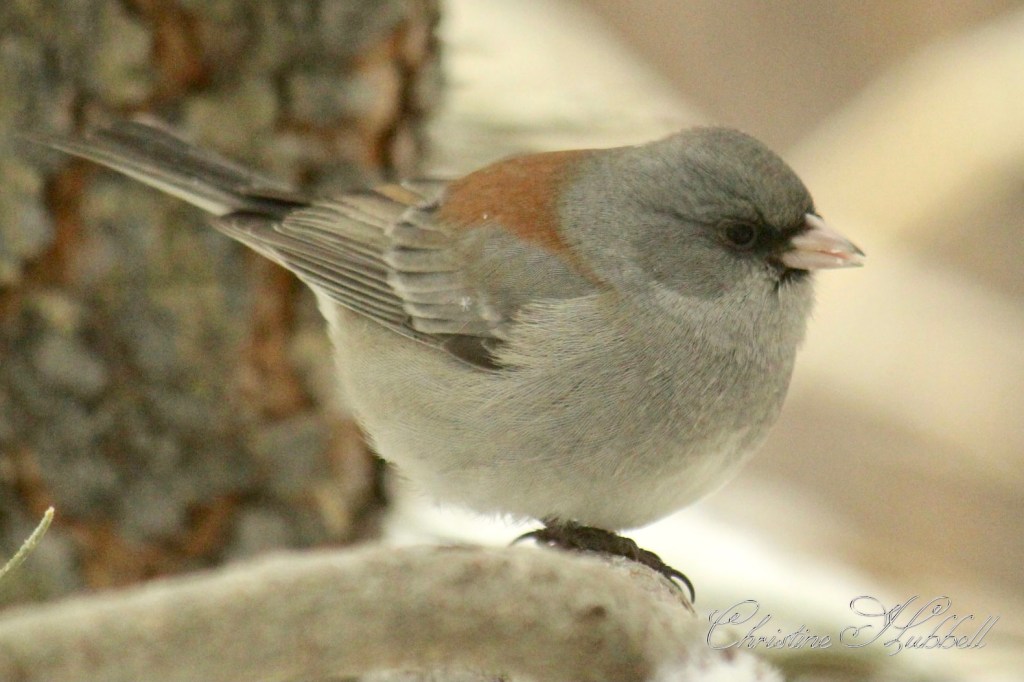
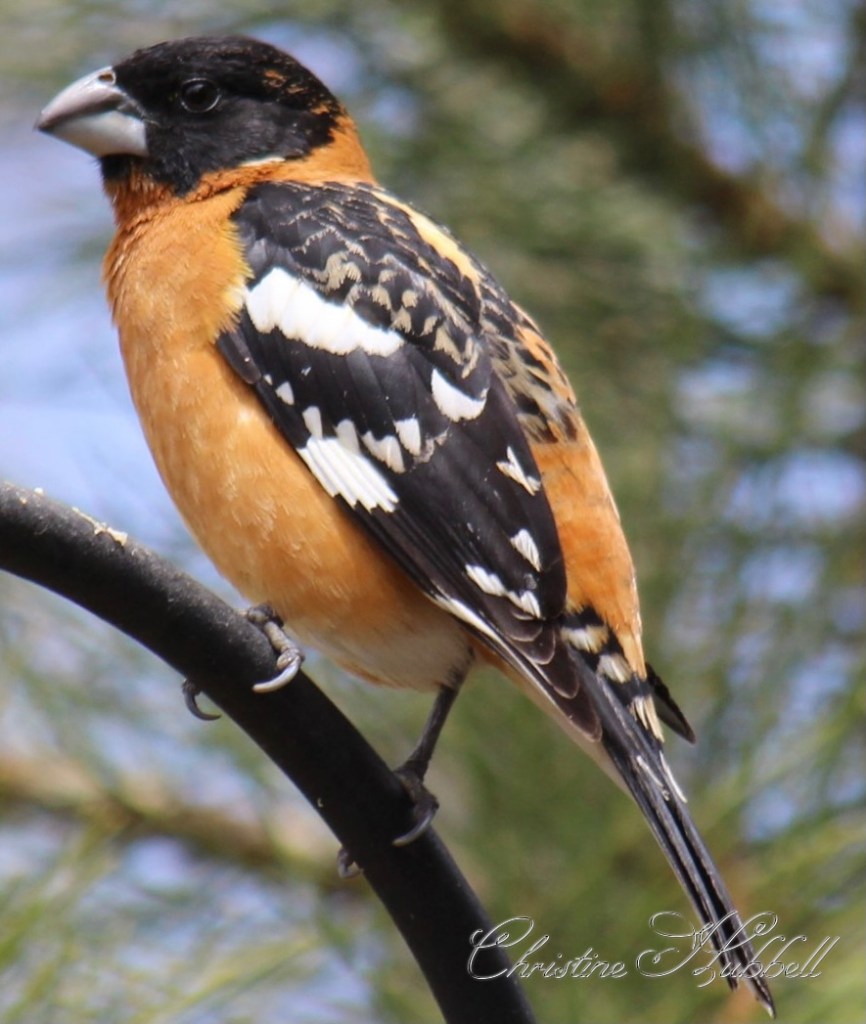
It’s May now, and migration season in Colorado is in high gear. Western Tanager, Bullock’s Oriole, and Black-headed Grosbeak are competing with a small, noisy flock of Pine Siskin for seeds and oranges. What a delight to sit here for an hour working with the birds, gently encoding all that behavior, noise, and color into memory.
It’s late winter, just around the corner from Valentine’s Day. It’s the perfect time to reflect on the many loves in my life, including my passion for birds, art, and science.
These three loves coalesce in the practice of natural science illustration, often referred to as “art in the service of science.” But science can also serve beauty. Accurate, detailed drawings can capture our imaginations and hearts in a way that leads us to curiosity, delight, and a desire to protect.
In the end we will conserve only what we love, we will love only what we understand, and we will understand only what we are taught.
Baba Dioum
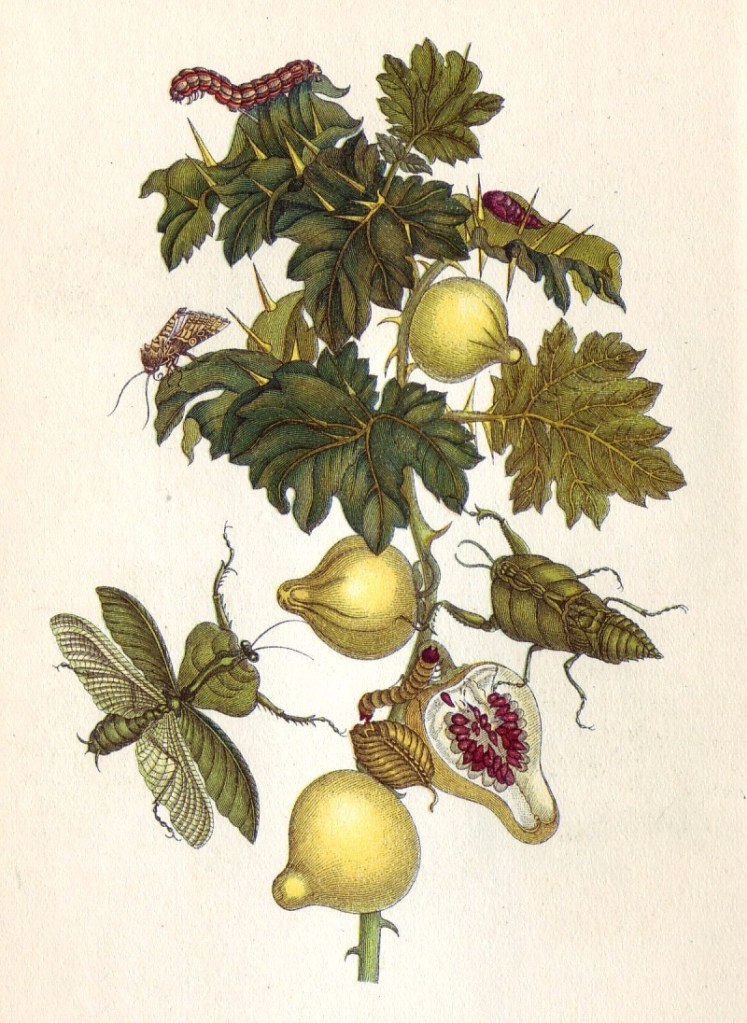
Maria Sibylla Merian 1705
In 1699, Maria Sibylla Merian left her home in Amsterdam and traveled with her daughter to Surinam where she continued her work as an entomologist and natural science illustrator. Sibylla Merian was an entomologist, illustrator, and publisher. Her work redefined what was known about metamorphosis. You can see in her engravings and paintings how lavishly she loved what she encountered.
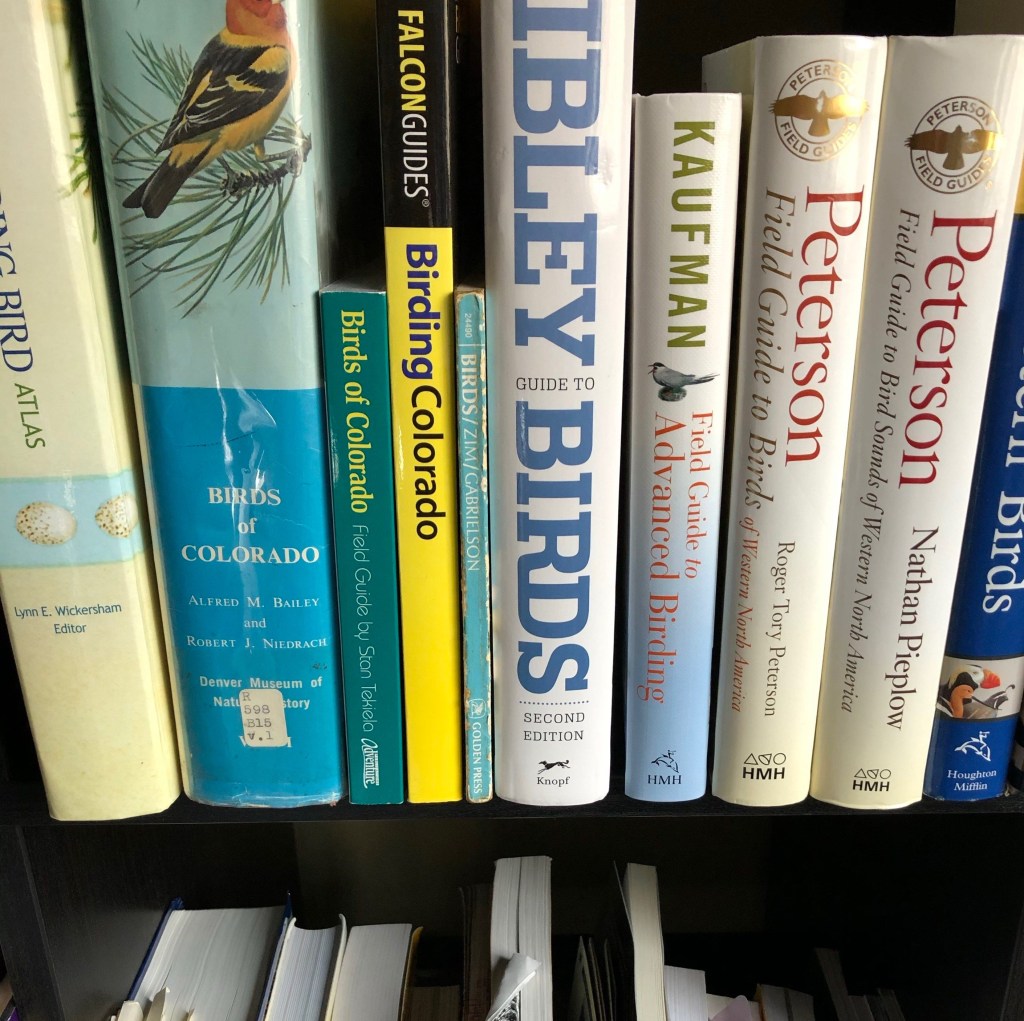
Today we encounter natural science illustration almost everywhere we look. If you’re a birder, you probably have at least one field guide on your shelf. We rely on the adept illustrations of each species to help us identify birds (and other life) in the field. But we may not be aware of the thousands of hours of research, field observation, and craft needed to produce these complex works. That’s what natural science illustrators excel at: simplifying complex scientific ideas with rigorous accuracy. This is a job for people with passion.
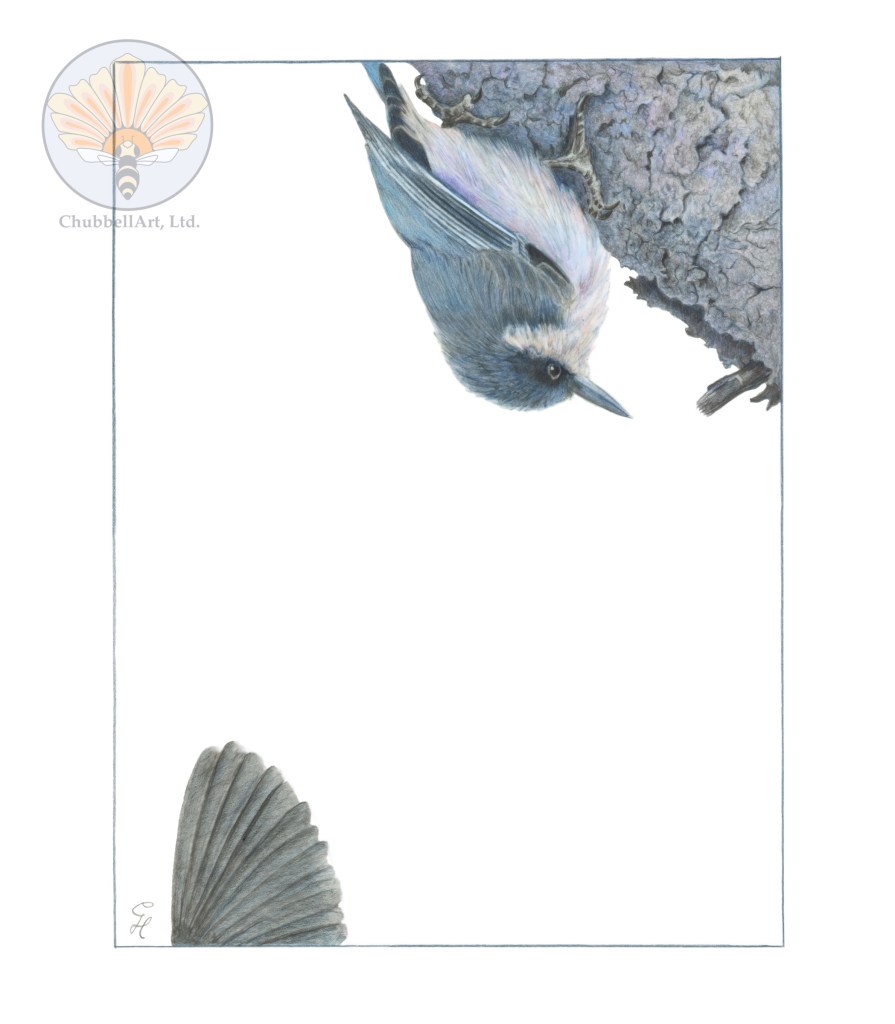
At the Denver Botanic Gardens School of Botanical Art and Illustration, I learned how to be rigorous in researching and understanding the plant species I illustrated. When I decided to concentrate on illustrating birds, I wanted to apply that same rigor, but with a shift in focus. I wanted to render birds as accurately as possible for the sheer joy of it. My hope is that the delight and joy of rendering the beauty of birds comes through in the lush details and colors, the soft textures, and even the scaly feet (always challenging for me to see properly, and endlessly fascinating). My bird studies are just beginning.
Pygmy Nuthatch / 2020 Copyright Christine Hubbell
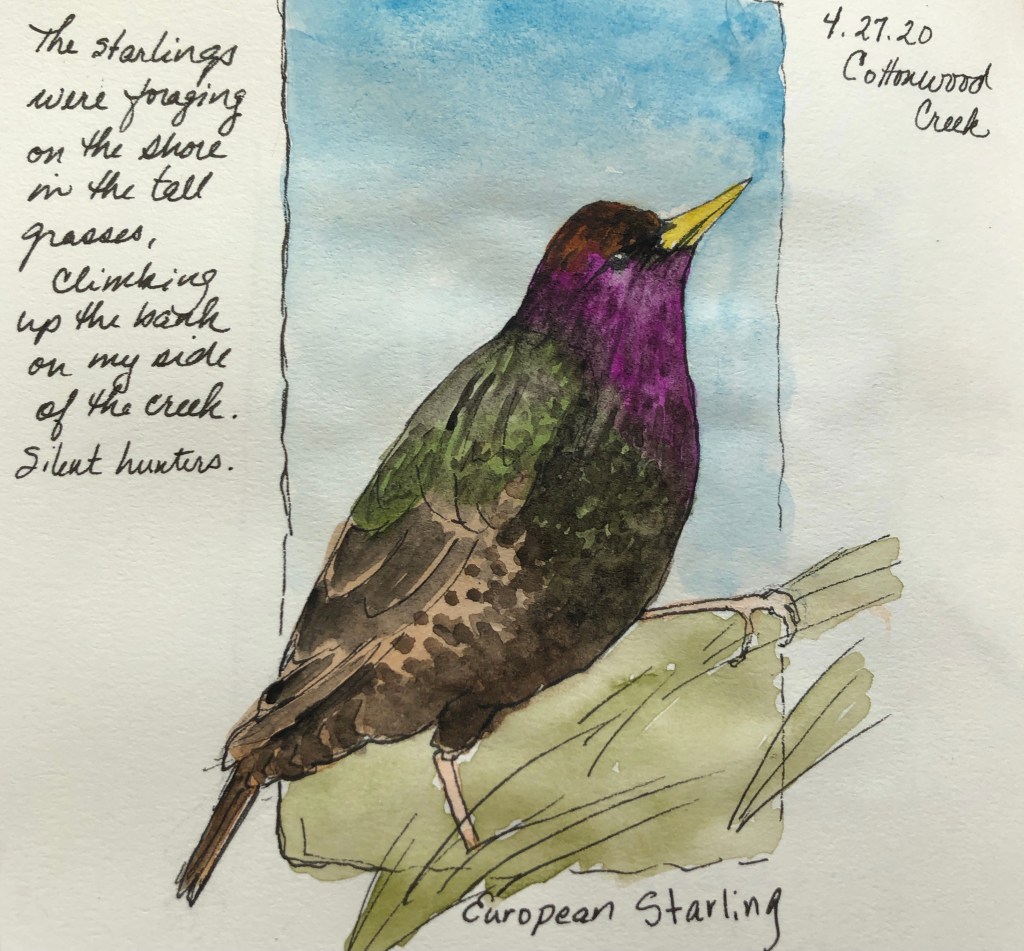
Drawing and illustrating birds is a highly rewarding, challenging practice. You can start at any age, and with the basic skills of handwriting. A great place to start is in your nature journal. This is where you record what you see, hear, and experience. And you don’t need big outdoor spaces. A porch, patio, or back yard will do. Record your observations over time and you’ll also have a rich historical record of your experiences.
Some of my favorite nature journaling resources are by John Muir Laws. His books on journaling, drawing birds, and teaching are carefully written, easy to follow, and enormously helpful. David Allen Sibley has wonderful process and drawing videos available from his website as well.
For all things bird, explore the amazing artists and educators at the Cornell Lab of Ornithology Bird Academy. They offer both real-time and recorded nature journaling workshops as part of their extensive series of classes and workshops.
Hermit Thrush / 2021 Copyright Christine Hubbell
There are so many reasons to love the artistry that allows us to understand birds, and so many reasons to love birds through making art. When we draw birds as a way of studying them, our minds shift to observing with intention. We learn to see aspects of birds that we would otherwise miss.
I’ve posted the following for anyone who’d like more time to draw along with the images in my Aiken Audubon nature art presentation.











 Christine Hubbell