This Mile a Swamp

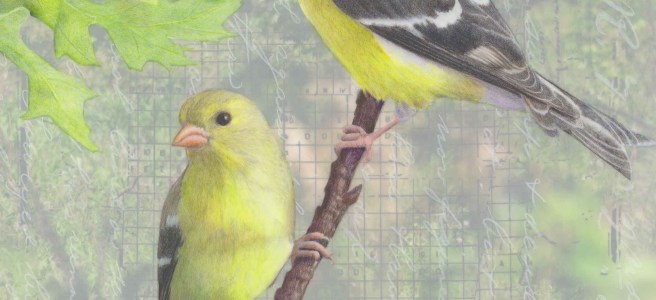
We love the feisty American Goldfinches at our winter feeders. They’re acrobatic, noisy, and occasionally fierce. By the middle of May, the males will sport banana yellow breeding plumage. That color was a challenge to capture in colored pencil. This pair is at home along Indiana roadsides–a habitat with a lot of history.

In the early 1800s, federal survey teams in Northwest Indiana mapped waterways, recorded natural resources, and marked the grid-like boundaries of land parcels. Each parcel was given a legal designation: a section within a numbered township (north or south of a baseline) and east or west of a numbered range line (i.e. Section 6, Township 34 North, Range 7 West). These parcels were subdivided and sold by the United States Government. 

Land sales raised money for the government and accelerated expansion into formerly indigenous territory. By the late 1830s, native people in Indiana had ceded much of their land through treaties and coercion. Other efforts to remove native people from Indiana included the 1838 Trail of Death, during which 859 people were forcibly marched from Twin Lakes, Indiana, to Kansas, and 42 people died. During these years, homesteaders and land speculators eagerly expanded into Indiana, clearing trees and plowing the prairies. 

The landscape we see today is a legacy of the work of the early survey teams. Modern farms are separated by long country roads, hedgerows, and weed strips. When the land was cleared in the 1800s, wildlife likely struggled with deforestation and the loss of wetlands. The location recorded in this piece was wetland before it was drained for agriculture. But birds like the American Goldfinch have adapted well to disturbed areas, open fields, and the seeds of edge-environment weeds. Today they are widespread residents of fields and gardens.

This piece is available for purchase. Please contact me for pricing.

Cicada Summer

The sound seems to drift down from the heights of the tall trees. It’s a dreamy, lazy buzzing, rising and falling in volume, and tapering off to be picked up again in a slightly different place. Growing up in Indiana, it was the background sound to the “dog days” of summer. I can’t separate my memories of freezer pops and visits to the Lake from the thrumming sound of the annual cicadas.

Our yard (3 acres of weedy grass, silver maple and black walnut) is revealing its wealth of insects this year (and other critters). Along the tree lines, I’m delighted by flying bugs, bees, spiders, and dragonflies. I discovered a tree frog sheltering from the sun, and rescued a handful of hungry monarch caterpillars that would have starved where they hatched. I moved them to bigger fare.

Gratitude seems like a small word to exchange for this bounty of wonders. I get to play out of doors as part of my job, and then generate something lovely from that play. The hours I spend outside observing, recording, watching, and listening are as important as the hours I spend in the studio creating, drawing, composing and rendering.

A new project is emerging from my summer’s work, as I process a deep dive into nature and local history. It combines my fine art paintings with genealogy and environmental education. You can follow along as I develop the project in upcoming posts.

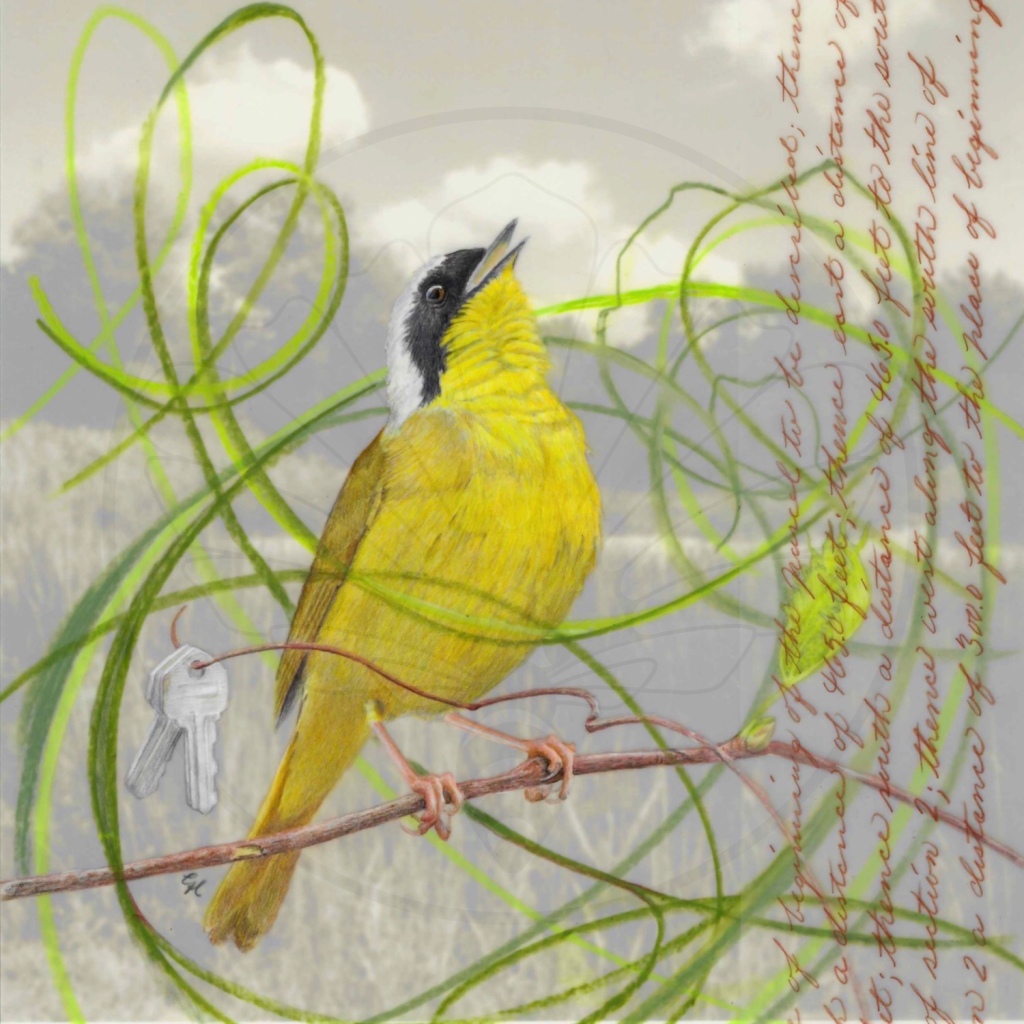
In the mean time, the first two pieces are almost complete. The first is called “Place of Beginning,” and reflects our move back to Indiana. The text is a partial legal description from our mortgage documents. This bird is emerging from chaos (have you ever moved across country?). It’s song is a clear bell coming from the storm of activity brought on by change.

Each piece in this new project will incorporate historic documents about a geographic location, feature, or region (such as the Kankakee River or the Indiana Dunes). The documents record changes in Northwest Indiana between the years of settlement (roughly 1830) to the first successes of the conservation movement in the early twentieth century (roughly 1925). I’m eagerly searching out diary entries, land survey notes, stories, poems and articles.

“Enter a Wet Prairie” explores the historic loss of habitat for grassland birds like the Dickcissel. The background photo is the restored prairie at Reynolds Creek Game Bird Area, and the historical document is the land survey note matching that location. Restoration efforts in Porter County are reclaiming land for tallgrass prairie, and there is hope that we can continue to enjoy grassland plants and animals into the future.

Thanks for making it to the end!. As a reward, please claim your free downloadable prairie kaleidoscope coloring page!