Cicada Summer

The sound seems to drift down from the heights of the tall trees. It’s a dreamy, lazy buzzing, rising and falling in volume, and tapering off to be picked up again in a slightly different place. Growing up in Indiana, it was the background sound to the “dog days” of summer. I can’t separate my memories of freezer pops and visits to the Lake from the thrumming sound of the annual cicadas.

Our yard (3 acres of weedy grass, silver maple and black walnut) is revealing its wealth of insects this year (and other critters). Along the tree lines, I’m delighted by flying bugs, bees, spiders, and dragonflies. I discovered a tree frog sheltering from the sun, and rescued a handful of hungry monarch caterpillars that would have starved where they hatched. I moved them to bigger fare.

Gratitude seems like a small word to exchange for this bounty of wonders. I get to play out of doors as part of my job, and then generate something lovely from that play. The hours I spend outside observing, recording, watching, and listening are as important as the hours I spend in the studio creating, drawing, composing and rendering.

A new project is emerging from my summer’s work, as I process a deep dive into nature and local history. It combines my fine art paintings with genealogy and environmental education. You can follow along as I develop the project in upcoming posts.

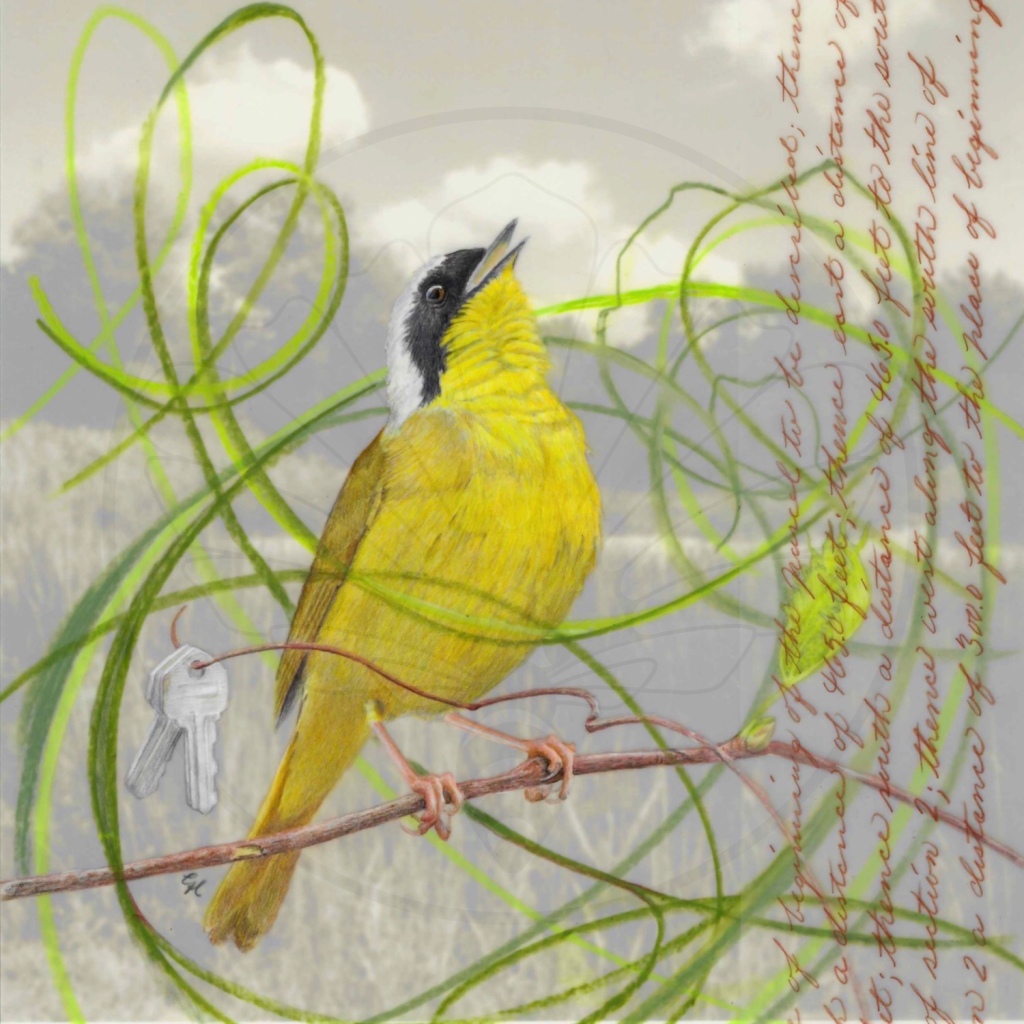
In the mean time, the first two pieces are almost complete. The first is called “Place of Beginning,” and reflects our move back to Indiana. The text is a partial legal description from our mortgage documents. This bird is emerging from chaos (have you ever moved across country?). It’s song is a clear bell coming from the storm of activity brought on by change.
Each piece in this new project will incorporate historic documents about a geographic location, feature, or region (such as the Kankakee River or the Indiana Dunes). The documents record changes in Northwest Indiana between the years of settlement (roughly 1830) to the first successes of the conservation movement in the early twentieth century (roughly 1925). I’m eagerly searching out diary entries, land survey notes, stories, poems and articles.

“Enter a Wet Prairie” explores the historic loss of habitat for grassland birds like the Dickcissel. The background photo is the restored prairie at Reynolds Creek Game Bird Area, and the historical document is the land survey note matching that location. Restoration efforts in Porter County are reclaiming land for tallgrass prairie, and there is hope that we can continue to enjoy grassland plants and animals into the future.

Thanks for making it to the end!. As a reward, please claim your free downloadable prairie kaleidoscope coloring page!

Drama in the Dunes

Recently, my friend Kristina and I met at the Great Marsh Trail in the Indiana Dunes National Park for nature journaling. I expected sunshine, mosquitos, lots of birds, and overgrown trails. I didn’t expect small dramas to unfold as we worked. Nature is teaching me to pay more attention.

It can be hard to settle down to observing and sketching. It turns out you can’t bird, and photograph, and sketch all the same time! And then you want a better look at a swallow, or are distracted by sandhill cranes honking in the distance. Somehow we managed to settle in. A cooperative Common Yellowthroat returned several times to sing from a favorite perch. Kristina captured his confident posture and made a beautiful sketch of his surroundings (see her wonderful avifauna paintings at KristinaKnowski.com)

Capturing a Common Yellowthroat in action. Copyright Kristina Knowski.

I had a long look at Canada Geese through my binoculars and enjoyed sketching them. They were rolling their heads at one another, and I wondered what they were communicating.

Birds are constantly in motion. Copyright Christine Hubbell.

Clouds moved in and the wind picked up. We headed east, hoping to find a viewpoint into the next marsh and maybe a peek at the cranes. We passed a turtle and a frog on the trail. What did they think of each other?

A storybook encounter? This Northern Leopard Frog seemed to be making the same journey as the turtle.

On our way out Kristina noticed a noisy confrontation unfolding just off the road. A variety of bird species were agitated, but it was the Oriole making the most racket. He was harassing a pair of red-shouldered hawks. I saw the female come in once, and we spotted a feisty robin approach, but otherwise the Oriole was on his own. We didn’t stay to see who won, but I left with loads of questions.

A dramatic encounter recreated from memory and photos, enriched by curiosity. Copyright Christine Hubbell.

Observation opens our curiosity in ways that can only be satisfied with more observation. Were the frog and turtle “together” on the trail? Or were they coincidentally moving from the wet marsh to drier land? Maybe we happened on a favored crossing zone. Had the hawks eaten recently? (They seemed disinterested in the kerfuffle they were creating.) How often do the hawks visit that spot?

Unanswered questions, excellent company, and a beautiful day are now woven into the pages of my journal, and I’m grateful for the ability to be aware and present in nature. I’m sure I’ll enjoy this rich set of memories during the darker and quieter days of winter.

Sand in My Shoes and a Song in My Heart

Memories surface like waves. The roar of the water on a windy day. The cool air juxtaposed against the heat of the sun on my skin. Sand pouring into the back of my shoes as I slide down a steep dune. I’ve been playing at the beaches along Lake Michigan’s shores since before I could walk. Many decades later, my joints are a bit stiff, and my skin is a little loose, but when I’m perched on a dune looking at the water, I feel young.

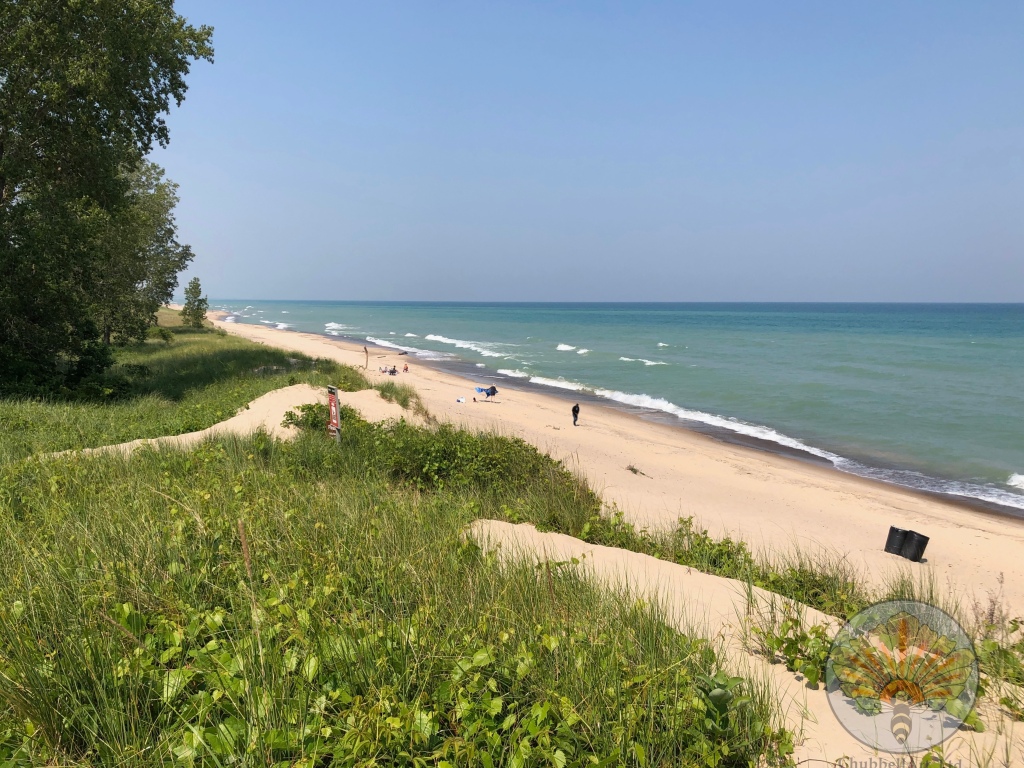
Photograph of sandy dunes sloping down to blue water at Dunbar Beach, Indiana Dunes National Park.
Brisk waves batter the shore. I can’t hear anything over the wind.

“Find a comfortable seat” is a basic guideline of nature journaling. This includes finding a comfortable place to sit or stand for the duration of sketching, and also taking good care of myself outdoors. No matter how long I plan to be out, I assume I’m doing a pack in/pack out day camp, complete with water, snacks, safety, and other comfort items. Sunscreen, bug spray, and for me, poison ivy wipes, are essential.

Photograph of artist sketching in the dunes. Close up of face.
Getting comfortable in the sand. Too windy for my big-brimmed hat!

After that, I let the rules drop away and enjoy myself. I have no idea what I’ll find to look at, and that’s part of the fun. Sometimes nothing grabs my interest, and I stare over the top of my sketchbook. It’s okay to be in the moment.

Blurry photo of dunes with sketchbook in the foreground demonstrating a nature journal entry.
Recording what I observe cements the experience in my memory. It’ll be fun to revisit this page during the dark days of winter.

I’ve taken the advice of a number of journal enthusiasts to start my page with a location map or landscape. On this trip, I loved the way the dune bluffs scalloped away from the water into the distance. I didn’t quite capture it, so I’m looking forward to going back. The nice thing about a landscape is that you can usually return more than once.

A Dune Tiger Beetle, genus Cicindela, on the hunt.

Another technique I’ve learned is to let my attention be drawn back from a distance to my immediate surroundings. That’s how I noticed one beetle chasing a much smaller beetle across the sand. Lunch!

George Fred Keck’s House of Tomorrow, moved to Beverly Shores from the Chicago World’s Fair. There are five Century of Progress homes. The other four have been leased to tenants who have restored their interiors. This home is currently being remodeled.

Dunbar Beach in Beverly Shores is now part of the Indiana Dunes National Park. But when I was growing up, the Century of Progress homes, the narrow sunlit beach, and the bend in the road at Kemil Beach were the nameless landmarks of our endless childhood summers. I love being back.

Things get a little sandy at the beach.