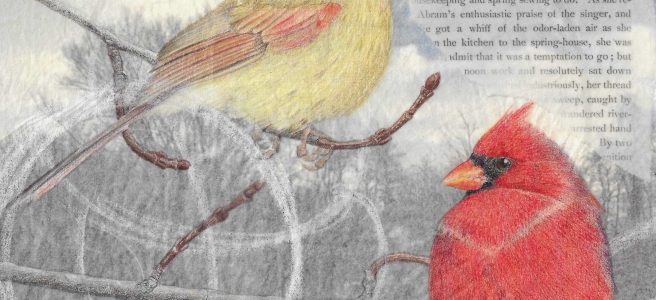
Few bird species are as iconic as the Northern Cardinal. Our love-affair with the Cardinal has a long history and has been used to help advance the goals of conservation. In 1903 Gene Stratton Porter published The Song of the Cardinal. Her plucky hero and heroine were a pair of newly mated birds keeping house at the edge of human habitat. In the book, an old farmer and his wife (Abram and Maria) become their admirers and protectors. Here I’ve included a page from the book, a moment when Maria decides to heed the Cardinal’s call to Come See! Come See!
I feel deeply emotional about It Was a Temptation, as Stratton-Porter intended with Song of the Cardinal. The deeply humanized birds at the center of her novel evoked a strong emotional response from a wide readership. Do anthropomorphic animal characters support the cause of conservation or blur the lines between human and animal needs? I don’t have an answer, but I believe we can enlarge our circle of care beyond our own families and communities when we empathize with other people and creatures.
I illustrated this piece on transparent paper, which has a different feel under my pencils than the drafting film. And when combined with the digital image underneath, it reveals and hides shapes and colors in its own way. I like the more rustic results.
Recently, my friend Kristina and I met at the Great Marsh Trail in the Indiana Dunes National Park for nature journaling. I expected sunshine, mosquitos, lots of birds, and overgrown trails. I didn’t expect small dramas to unfold as we worked. Nature is teaching me to pay more attention.
It can be hard to settle down to observing and sketching. It turns out you can’t bird, and photograph, and sketch all the same time! And then you want a better look at a swallow, or are distracted by sandhill cranes honking in the distance. Somehow we managed to settle in. A cooperative Common Yellowthroat returned several times to sing from a favorite perch. Kristina captured his confident posture and made a beautiful sketch of his surroundings (see her wonderful avifauna paintings at KristinaKnowski.com)
Capturing a Common Yellowthroat in action. Copyright Kristina Knowski.
I had a long look at Canada Geese through my binoculars and enjoyed sketching them. They were rolling their heads at one another, and I wondered what they were communicating.
Birds are constantly in motion. Copyright Christine Hubbell.
Clouds moved in and the wind picked up. We headed east, hoping to find a viewpoint into the next marsh and maybe a peek at the cranes. We passed a turtle and a frog on the trail. What did they think of each other?
A storybook encounter? This Northern Leopard Frog seemed to be making the same journey as the turtle.
On our way out Kristina noticed a noisy confrontation unfolding just off the road. A variety of bird species were agitated, but it was the Oriole making the most racket. He was harassing a pair of red-shouldered hawks. I saw the female come in once, and we spotted a feisty robin approach, but otherwise the Oriole was on his own. We didn’t stay to see who won, but I left with loads of questions.
A dramatic encounter recreated from memory and photos, enriched by curiosity. Copyright Christine Hubbell.
Observation opens our curiosity in ways that can only be satisfied with more observation. Were the frog and turtle “together” on the trail? Or were they coincidentally moving from the wet marsh to drier land? Maybe we happened on a favored crossing zone. Had the hawks eaten recently? (They seemed disinterested in the kerfuffle they were creating.) How often do the hawks visit that spot?
Unanswered questions, excellent company, and a beautiful day are now woven into the pages of my journal, and I’m grateful for the ability to be aware and present in nature. I’m sure I’ll enjoy this rich set of memories during the darker and quieter days of winter.
For me, March is the opening of the creative season. As the studio fills with new ideas, the world pivots from darkness to light, from the quiet waiting of Winter to full-throated Spring. It’s a good time for reflection. My artwork continues to evolve, but with familiar components—a love of beauty, a prayer for conservation, a hope of connection.
Eastern Bluebirds in progress, on a cake plate with peach and lottery ticket. Colored pencil on drafting film.
My recent colored pencil paintings capture imaginary wildlife encounters in human spaces, blending storytelling with natural science illustration. They place birds in human-made settings, echoing the role we play in shaping and controlling wildlife habitat. I’m never sure where the whimsy comes from, but I need that playfulness to round out my compositions.
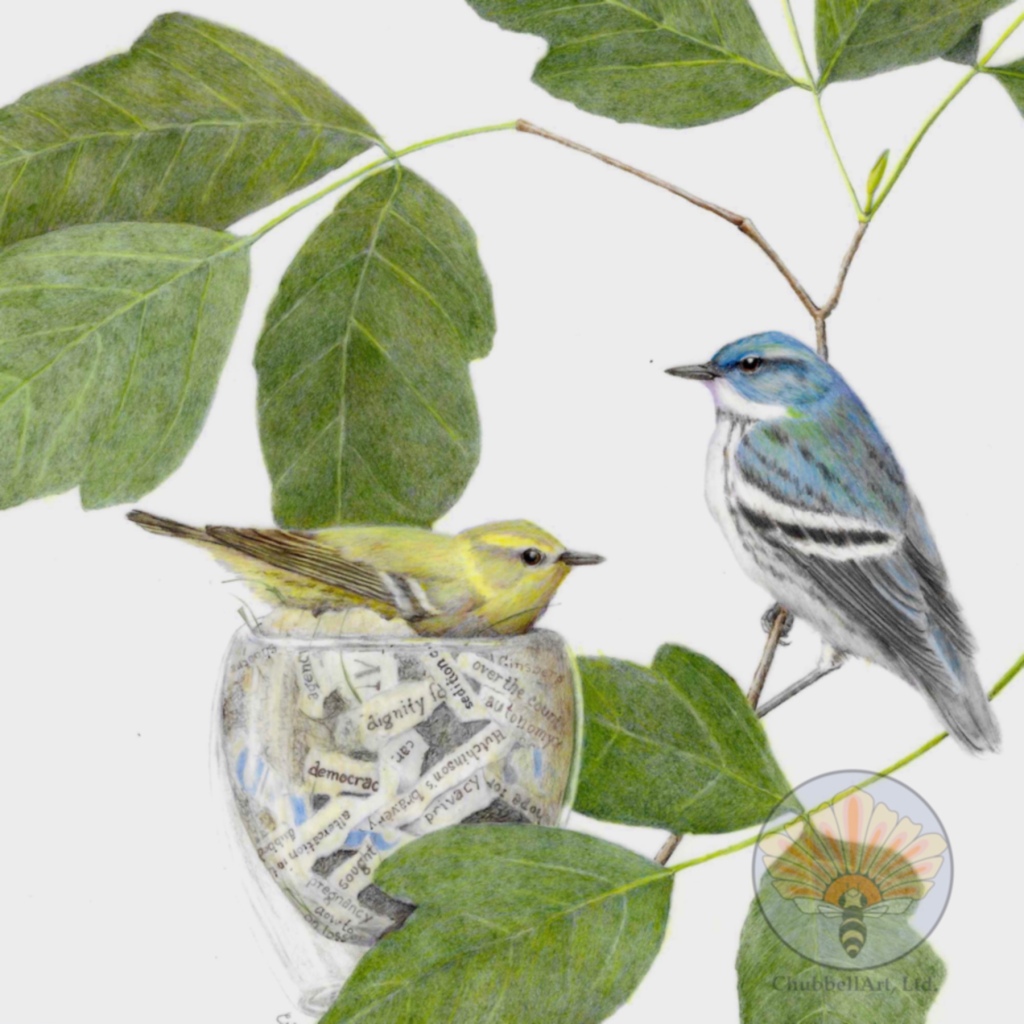
I created “Folly” in response to seeing nesting Cerulean Warblers at a birding festival. Through the scope, we watched the male and female tending their nest, tucked in the crook of a branch about 20 feet directly above a busy trail. It reminded me that birds have a precarious life, often struggling to succeed in challenging conditions.
“Folly.” Colored pencil on drafting film. Selected for the Hoosier Women Artists Exhibition 2023, it’s on display for a year at the Indiana State House.
I illustrated the nest as a glass cup filled with the news of the day, a fragile and potentially disastrous choice. I surrounded them with Poison Ivy, which has a dual nature. It’s terrible for us, but beneficial for birds. I titled this piece “Folly” because foolishness is a good place to begin any journey. In foolishness we find the confidence to trust we’ll find what we need along the way.
I don’t know where my muse is taking me this year, but if it’s a Fool’s Journey, it’s bound to be interesting.
I love to use mixed media in my nature journal. That means making tough choices about how many pencils and pens to bring along, and what types of color media to include. This post explores ways to mix up your color tools without breaking the bank, and without loading down your sketching kit.
Nature sketching with color can be quick and light
A basic kit might contain nothing more complicated than a sketchbook and a pencil. Add a bottle of water (and any necessary comfort items), and you’re ready to go. This is a light option, not just in terms of ounces, but in terms of attention. You won’t be distracted by extra supplies – Did I lose my eraser? Where is that darned sepia Inktense???
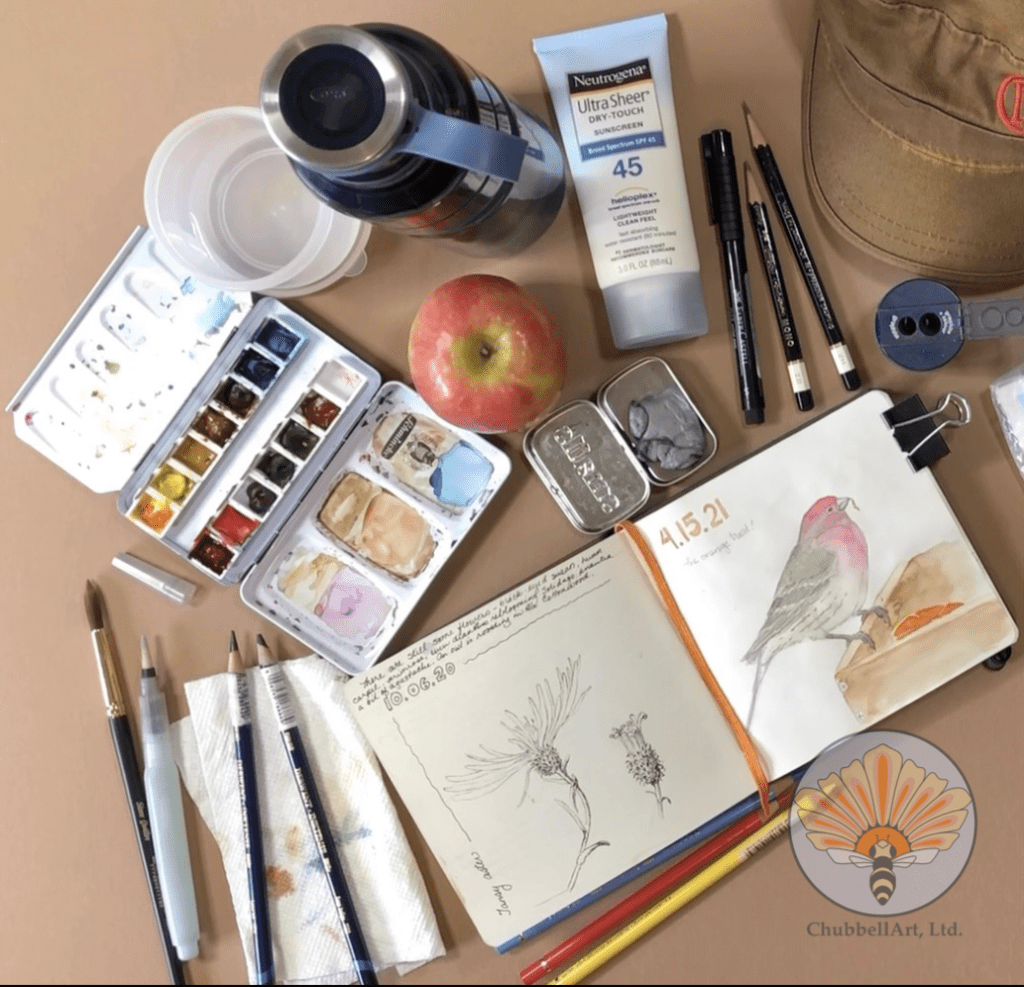
My basic nature sketching kit
So when I want to bring color along, I try to keep it simple and go for tools that are lightweight and offer little distraction. I have a small watercolor palette, which requires a brush and a bottle of water. This is my “fussy” choice. Or, I might bring water color pencils (a few, not the whole set!) and a water pen (a nylon brush with its own water reservoir). Occasionally, I’ll trim my kit down to just three colored pencils: red, blue (or black) and yellow. I mean, you can make any color of the rainbow with those, right?
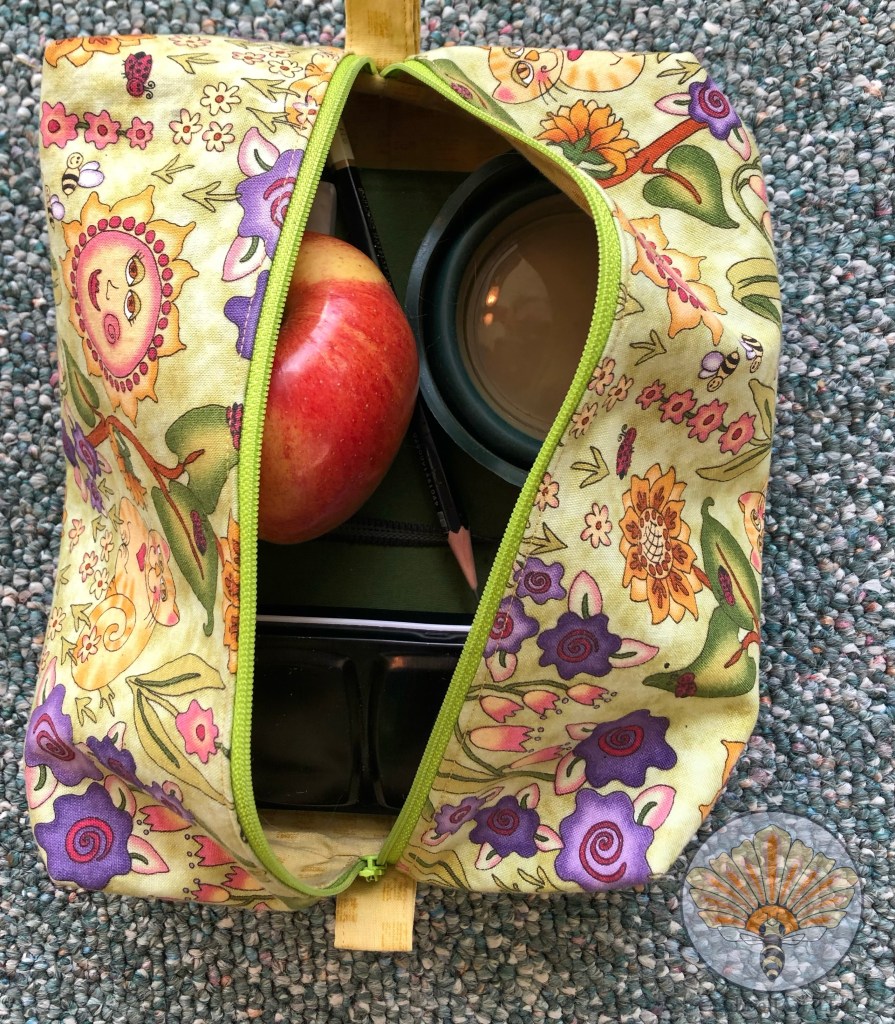
Everything fits inside this zip bag, then tucks into a backpack.
By packing thoughtfully, I can bring a small range of colors in multiple media. This lets me have fun with layering them in one sketch. For example, I might apply water color pencil, then reinforce it with regular colored pencil after the paper has dried.
Lay down water color pencil, then activate it. Once dry, top with regular colored pencil or graphite.
I also like to create my own coloring pages of birds and flowers from my nature journal. I start with a sketch, outline significant lines in permanent ink, and let the ink dry. Once I erase the pencil, I’ve got a lovely contour drawing, perfect for sharing. If I’m still out of doors, I snap a photo, color the original, and keep layering!
Make your own coloring page by inking in your lines and erasing the graphite.
I can also capture the tones of a subject with just ink or graphite, and leave color for later (or not at all). Colored pencil, water color, and marker can all be layered over the graphite, which will also help to seal the graphite in place (less smudging).
For darkest areas, try starting light, then crisping up edges and lines as you get darker.
For me, keeping a light kit makes a sketching session easy and unlabored. And the more I enjoy my nature sketching session, the more likely I am to grab my kit and head outdoors, which of course increases my enjoyment. So pack light, and get out there!
It’s late winter, just around the corner from Valentine’s Day. It’s the perfect time to reflect on the many loves in my life, including my passion for birds, art, and science.
These three loves coalesce in the practice of natural science illustration, often referred to as “art in the service of science.” But science can also serve beauty. Accurate, detailed drawings can capture our imaginations and hearts in a way that leads us to curiosity, delight, and a desire to protect.
In the end we will conserve only what we love, we will love only what we understand, and we will understand only what we are taught.
Baba Dioum
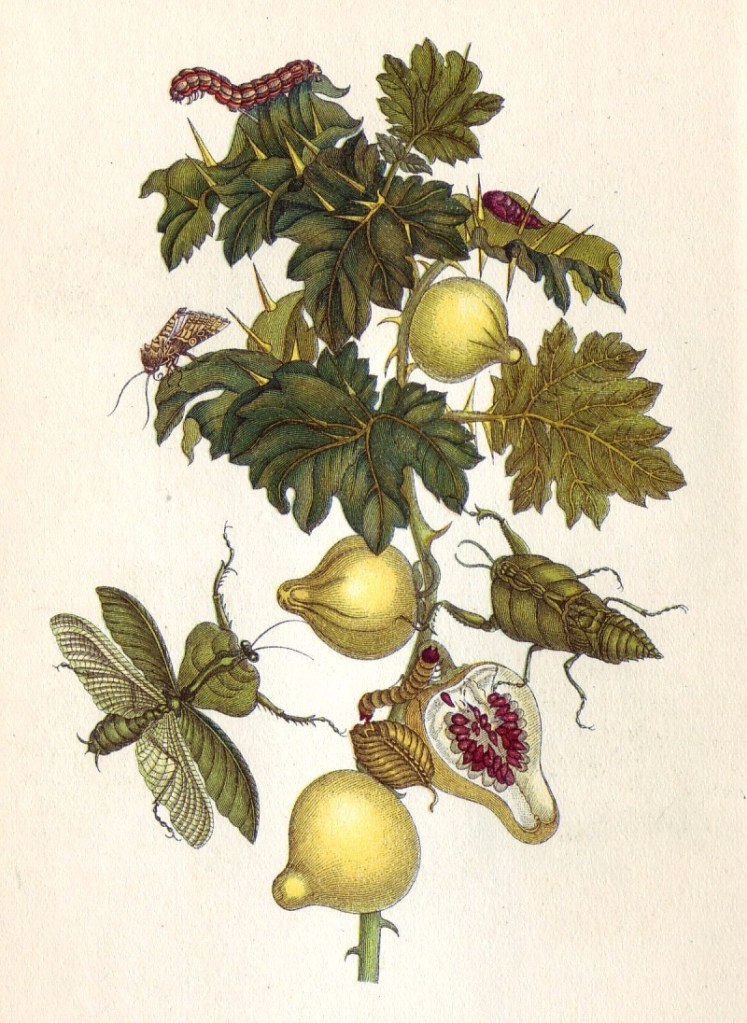
Maria Sibylla Merian 1705
In 1699, Maria Sibylla Merian left her home in Amsterdam and traveled with her daughter to Surinam where she continued her work as an entomologist and natural science illustrator. Sibylla Merian was an entomologist, illustrator, and publisher. Her work redefined what was known about metamorphosis. You can see in her engravings and paintings how lavishly she loved what she encountered.
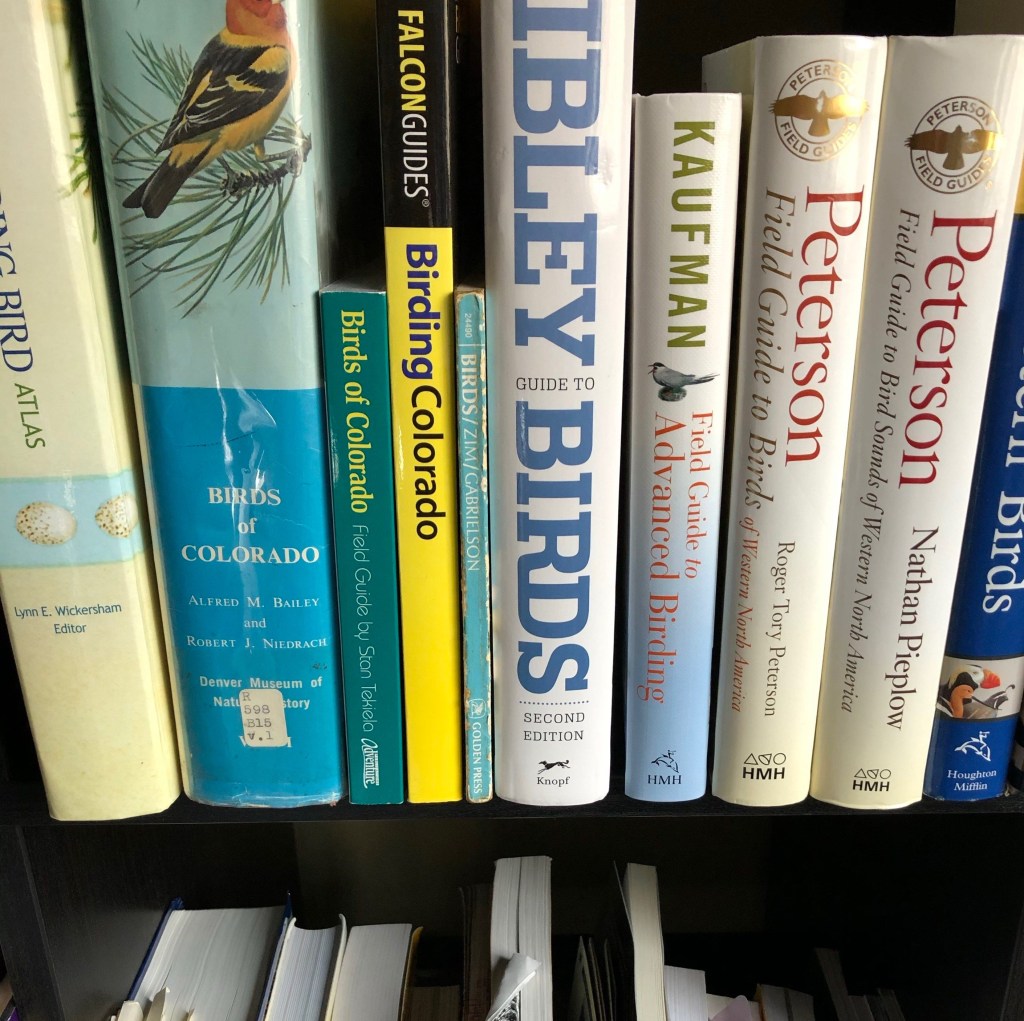
Today we encounter natural science illustration almost everywhere we look. If you’re a birder, you probably have at least one field guide on your shelf. We rely on the adept illustrations of each species to help us identify birds (and other life) in the field. But we may not be aware of the thousands of hours of research, field observation, and craft needed to produce these complex works. That’s what natural science illustrators excel at: simplifying complex scientific ideas with rigorous accuracy. This is a job for people with passion.
At the Denver Botanic Gardens School of Botanical Art and Illustration, I learned how to be rigorous in researching and understanding the plant species I illustrated. When I decided to concentrate on illustrating birds, I wanted to apply that same rigor, but with a shift in focus. I wanted to render birds as accurately as possible for the sheer joy of it. My hope is that the delight and joy of rendering the beauty of birds comes through in the lush details and colors, the soft textures, and even the scaly feet (always challenging for me to see properly, and endlessly fascinating). My bird studies are just beginning.
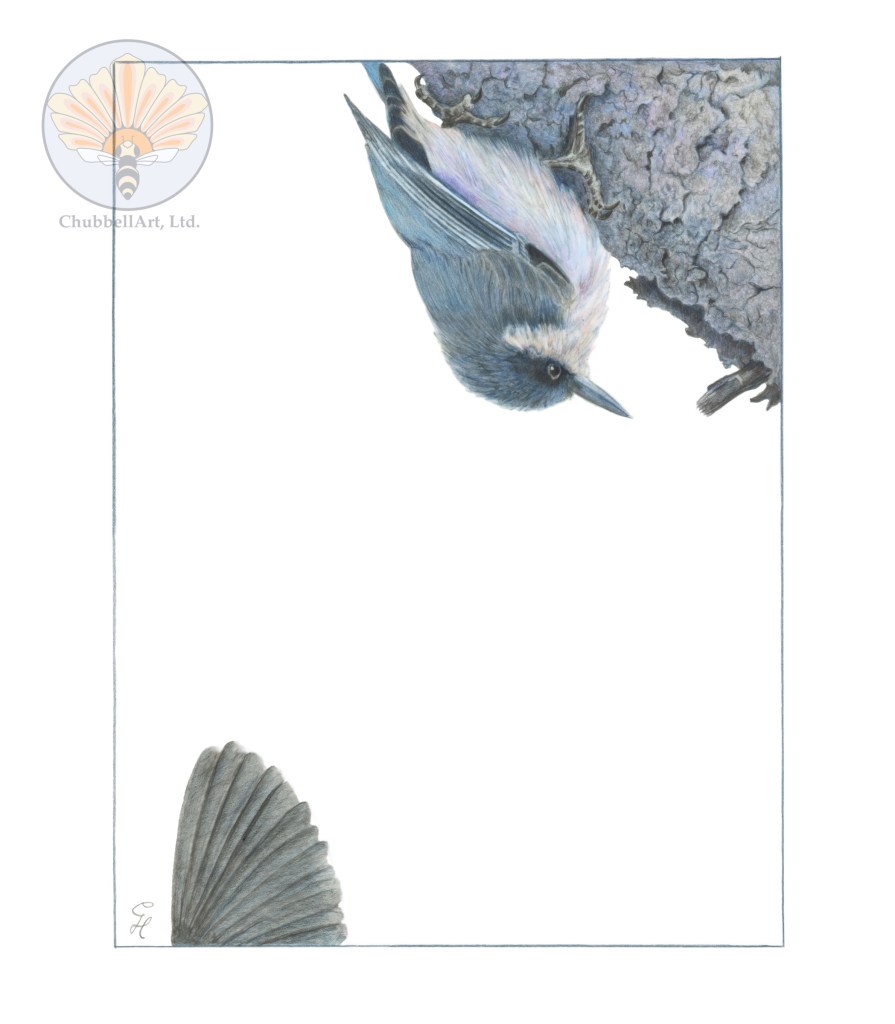
Pygmy Nuthatch / 2020 Copyright Christine Hubbell
Drawing and illustrating birds is a highly rewarding, challenging practice. You can start at any age, and with the basic skills of handwriting. A great place to start is in your nature journal. This is where you record what you see, hear, and experience. And you don’t need big outdoor spaces. A porch, patio, or back yard will do. Record your observations over time and you’ll also have a rich historical record of your experiences.
Some of my favorite nature journaling resources are by John Muir Laws. His books on journaling, drawing birds, and teaching are carefully written, easy to follow, and enormously helpful. David Allen Sibley has wonderful process and drawing videos available from his website as well.
For all things bird, explore the amazing artists and educators at the Cornell Lab of Ornithology Bird Academy. They offer both real-time and recorded nature journaling workshops as part of their extensive series of classes and workshops.
Hermit Thrush / 2021 Copyright Christine Hubbell
There are so many reasons to love the artistry that allows us to understand birds, and so many reasons to love birds through making art. When we draw birds as a way of studying them, our minds shift to observing with intention. We learn to see aspects of birds that we would otherwise miss.
I’ve posted the following for anyone who’d like more time to draw along with the images in my Aiken Audubon nature art presentation.
They say the little black dress never goes out of style. It’s simple and can anchor an entire wardrobe. Maybe that’s why I love working in graphite. When I’m overwhelmed with juggling color, it feels good to go back to the basics. Composition, value, and shape. Graphite is the little black dress of my art wardrobe.
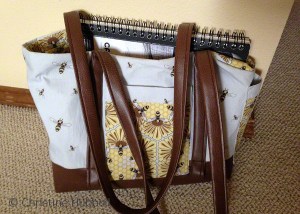
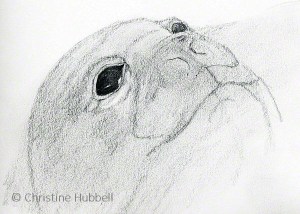
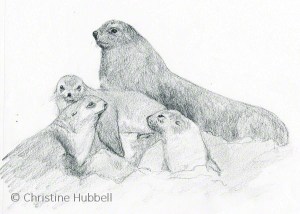
Some of my favorite drawings are smudgy graphite sketches. Smudgy is good because it adds instant mid tones. I like to work on toned paper, too, but lately I’ve been heading out with nothing more exciting than a 2B pencil, an eraser, and my Canson sketch pad – the perfect “go anywhere” medium. I’ll confess to a little color excitement here. I made this bag from fabric I designed last year. It’s the perfect companion for sketching trips to the Denver Museum of Nature and Science.
We often get an audience when we’re working in front of the natural history dioramas. This trip, I showed one summer camper how easy it is to pick out shapes with a kneaded eraser and smudge them back in again when I don’t like the results. “It’s like magic!” she said. I agree – a happy kind of magic where drawing is more like painting.
After scribbling in some tone and smudging it with my finger (which is not exactly archival, but hey, it’s just sketching), I lay in a few shapes and pull out highlights, then work in the details. It’s relaxing to sit very still and look carefully, rechecking proportions and reshaping something to be more accurate.
So bloom on, tawdry flowers of summer. I know you’re calling to me too, but for now I’ll wear basic black. And shades of grey.





 Christine Hubbell