Tips for Sketching Trees

Ink and colored pencil nature journal sketch of a tree

We just had a cold snap here in Colorado Springs, with night-time temperatures dipping below 40. Mornings have a crisp chill that makes it hard to get out of bed, and spots of gold and russet signal the beginning of Autumn. Nature is pointing us toward a quieter cycle, and a last chance to sketch deciduous trees before they drop their leaves for winter. It’s the perfect time to share some quick tips for sketching trees.

Nature journal ink and water color sketch
Copyright 2021 ChubbellArt, Ltd.

Cottonwoods and Mountain Ash, American Plum, Gambel Oak and Willow, and even the little Common Hoptree sapling in our yard will be putting on fall color soon. So while the days continue to warm into the 70s and low 80s, I get my kit and head down to the park.

Nature journal sketch of an oak tree
Copyright 2021 ChubbellArt, Ltd.

I remember the first advice I got about sketching trees: “Don’t draw lollypop trees.” “Don’t try to draw every leaf.” That leaves (ha ha!) quite a bit of room for the unknown! So let’s back up a step to prepare for sketching by looking intentionally at different aspects of trees.

Diagram suggesting where to sit while sketching a tree
Sit far enough from the tree to see all of it without straining. Copyright 2021 ChubbellArt, Ltd.

Start by finding a comfortable seat far enough from the tree so you can see all of it without moving your head. By asking productive questions, you can break the tree apart to understand it, then put all the pieces back together in a coherent way. Here are some questions to get you started:

  • Can you pick one shape that represents the tree? Maybe it’s a diamond or a cone, a sphere or even a cube. The shape of the tree may be typical for its species.
  • Is the tree in direct sunlight or shade? How do the shadows create the three-dimensional form of the tree? How might they change in the next 15 minutes? The next hour?
  • How does the tree grow? Working from the roots and trunk upward, how do the main branches divide from the trunk, and what are those branches like? How many branches can you see peeking through the leaves or needles? Is the trunk single or double? Is it straight, gnarled, split?
  • What shapes do the leaves or needles make as they form clumps along the branches? Cones? Cubes? Spheres? Can you see individual leaves? What shapes are the leaves? Leaf shape is also a way to identify a tree species, so you might want to sketch the leaves separately.
  • What’s unique about this tree? Are there interesting bits of sky visible between leaves or branches? Does the tree have a cavity or a nest?
  • What do you love about the tree? Something drew you to this spot. What was it?

You can start to record your observations at any point, just know that you’ll want to make adjustments while you work. Start with a light touch in pencil or pen, then reinforce the lines as you work. I like to create an “envelope” based on the ratio of the tree’s height to width. I draw the envelope first, then cut in the overall shape of the tree. Inside the shape, I place the landmarks I’ve observed. These landmarks are essential for getting the details in the right places. There’s a time-lapse video at the end of this post that shows my process.

Ink and water color nature journal sketch of trees
Branches are a lovely subject for studying negative space. Copyright 2021 ChubbellArt, Ltd.

Deciduous trees offer us that last beautiful gasp of color before they drop their leaves in the fall. The golds and yellows we get here in Colorado won’t peak for another week or two. But I know that bare branches are just around the corner, and just as fun to sketch!

Transforming Winter

Sunshine on Cottonwood Creek

I used to hate winter, especially the month of November. Here in Colorado, fall leaves hit peak color toward the end of October. We’ve had our first or second snow. The winds pick up, then die off, and November sets in. November days are stark, short, and ugly. At least, that’s how I used to think of them.

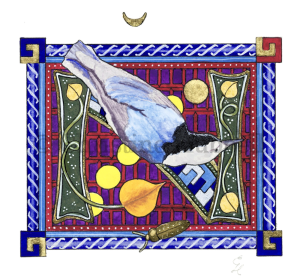
I believe that making and viewing art is transformative. My attitude toward November took a 180 degree turn when I spent part of the month designing and painting a small illumination based on the letter “N.” At first it had nothing to do with November. Just nuthatches. I’d been seeing them in my yard and went looking for them down at the creek.

Red-breasted Nuthatch

At the creek I met a lovely fellow birder who knew exactly which trees the nuthatches were using. Cathy pointed me toward a couple of hollow Cottonwood branches and there they were. We heard them, too. Nuthatches have a squeaky balloon chatter that’s unmistakable once you catch on.

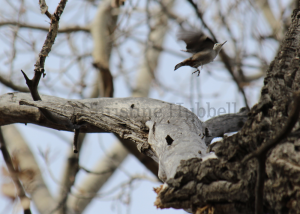
White-breasted Nuthatch in flight

The more time I spent outdoors looking for nuthatches, the more I noticed that the days were not just dry and short, they were also warm and soft and beautiful. Birds sang everywhere. The water in the creek had a particularly bright sheen from the low, south-driven sun. I couldn’t possibly be warming up to November, could I?

But there it was, creeping into my design for the illumination. The winter sun moving across the sky. The nuthatch prying at the bark of a Cottonwood amid scattered leaves. A sense of stillness at the center of a season in transition. This was my early winter meditation, and it transformed how I felt about those bleak November days.

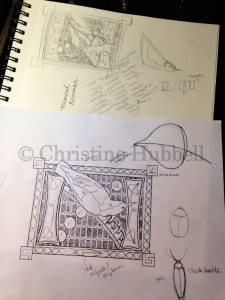
Illuminated N Sketches

I learned illumination techniques from Renee Jorgenson, who is a wonderful artist, teacher, and master calligrapher. The process starts with a small design, no more than 4 inches square. Every element is carefully planned, from the letter form to the motifs and background patterns. Gold leaf goes down first, then flat color applied with gouache. Black ink and white or pastel details make the colors pop and add visual interest. When it’s successful, you get that sense of a medieval manuscript illuminated with jewel-toned colors. A mini stained glass window on paper.

Illuminated N

I scanned this piece and used it for Christmas cards, but its legacy is that I will always associate it with enjoying the month of November. I hope it speaks to you, too, because there are more tough winter months coming. February can be dark and cold. But “F” is also for flicker, and I think we’re ready for it.

When Art Breaks Your Heart

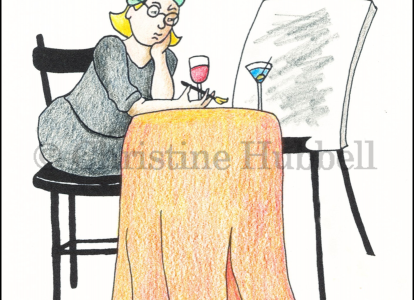
it's definitely you cartoon

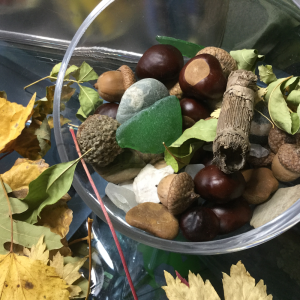
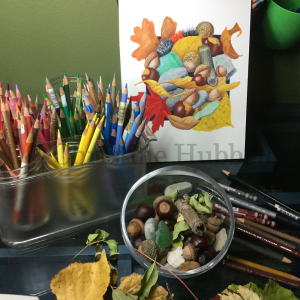
Fall. The colors, the textures, and the chilly nights all make me want to snuggle into the studio a little more deeply. A collection of fall treasures in a terrarium bowl was too romantic to pass up. But my dream of turning a medley of buckeyes and beach glass into fabric for table linens almost broke my heart.

glass bowl with leaves and tree nuts

At first it was golden. I tossed off a composition in record time. I especially loved illustrating the buckeyes. For this project I wanted something looser, richer, and more saturated than colored pencil. I was going to need a new medium. And that’s where things got messy.

graphite sketch

Experimenting with markers both under and over Neocolor II water soluble crayons was exhilarating. And I didn’t just punt. I did my homework, made a color chart. I thought saturation would be more important than “natural” colors. After all, I was designing fabric. Oh, what we tell ourselves in the beginning.

a sample of color swatches

After days at the drafting table I had to admit things weren’t exactly “good” between me and my art. The colors were electric and the values were mostly nonexistent. I was tempted to cut my losses and move onto something else. But after making a value study I decided I really did like the composition. Was I willing to start the illustration again? Sigh. Would it be worth it?

I started over. Finally, I was ready to make a scan and attempt the crazy process of layering the edges for a repeating pattern. What I almost got was an epileptic seizure. I could have cried.

bright fall medley fabric design

In every relationship there comes that moment when you mentally tally the pros and cons. I kept coming back to the beach glass and the overall composition. If I could just tone down the yellows. Pop the greens. Deepen the values.

I would give this relationship/project one more day, and several layers of colored pencil applied carefully, and lovingly, on top of the Neocolors. I also adjusted the scan before starting from scratch on the fabric design. I’m definitely happier with this version. But am I still in love?
detail of fabric design

I’ll let you know when the fabric arrives. Until then, happy fall!
fall medley illustration at the drawing board

Five Pages at the Zoo

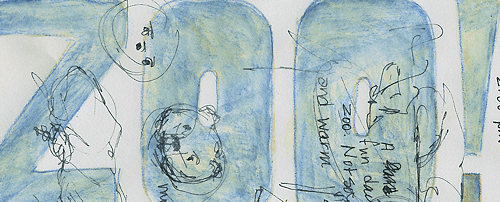
zoo

Saturday was incredibly warm, and a perfect day for the zoo. Though we love the animals and the hilly terrain of our local zoo, “Stout Month” at a favorite Denver brewery drew us north — to a city-scape of shirtless joggers, flip-flopped teens, and sun-soaked animals.

As soon as we passed the entrance gate at the Denver Zoo, we noticed two quiet dik-diks warming in the sun. Over the next two hours, I stopped for a minute or two every few feet, wedging myself into a little space in front of crowded enclosures. It was a nice “museum pace” that worked for me and didn’t bore my husband.

Dik-dik animal sketch

I found myself using each opportunity to try something different. When animals were backlit by the afternoon light, it was easy to read the shadows as abstract shapes and quickly put them in place to build form.

Dromedary camel

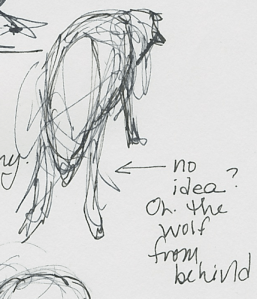
I tried to look more than draw, concentrating on understanding proportions and shape relationships. As a result, I made lots of blind contour scribbles. This was a great exercise, but I was messing up my journal.

ink sketch

I was tempted to rip out these five pages. I also wanted to keep my memories of a lovely day at the zoo. Back at home, I decorated the pages with watercolor pencil, and I think that’ll do the trick for me. This fits better with the neat-freak vibe of the rest of my journal, and the words reflect what I was thinking about while I sketched.

It won’t be long before warm weather returns, and we’ll visit our own Cheyenne Mountain Zoo. After all, it’s a short trip from the zoo to another favorite watering hole – the excellent Bristol Brewing tap room.