Cicada Summer

The sound seems to drift down from the heights of the tall trees. It’s a dreamy, lazy buzzing, rising and falling in volume, and tapering off to be picked up again in a slightly different place. Growing up in Indiana, it was the background sound to the “dog days” of summer. I can’t separate my memories of freezer pops and visits to the Lake from the thrumming sound of the annual cicadas.

Our yard (3 acres of weedy grass, silver maple and black walnut) is revealing its wealth of insects this year (and other critters). Along the tree lines, I’m delighted by flying bugs, bees, spiders, and dragonflies. I discovered a tree frog sheltering from the sun, and rescued a handful of hungry monarch caterpillars that would have starved where they hatched. I moved them to bigger fare.

Gratitude seems like a small word to exchange for this bounty of wonders. I get to play out of doors as part of my job, and then generate something lovely from that play. The hours I spend outside observing, recording, watching, and listening are as important as the hours I spend in the studio creating, drawing, composing and rendering.

A new project is emerging from my summer’s work, as I process a deep dive into nature and local history. It combines my fine art paintings with genealogy and environmental education. You can follow along as I develop the project in upcoming posts.

In the mean time, the first two pieces are almost complete. The first is called “Place of Beginning,” and reflects our move back to Indiana. The text is a partial legal description from our mortgage documents. This bird is emerging from chaos (have you ever moved across country?). It’s song is a clear bell coming from the storm of activity brought on by change.
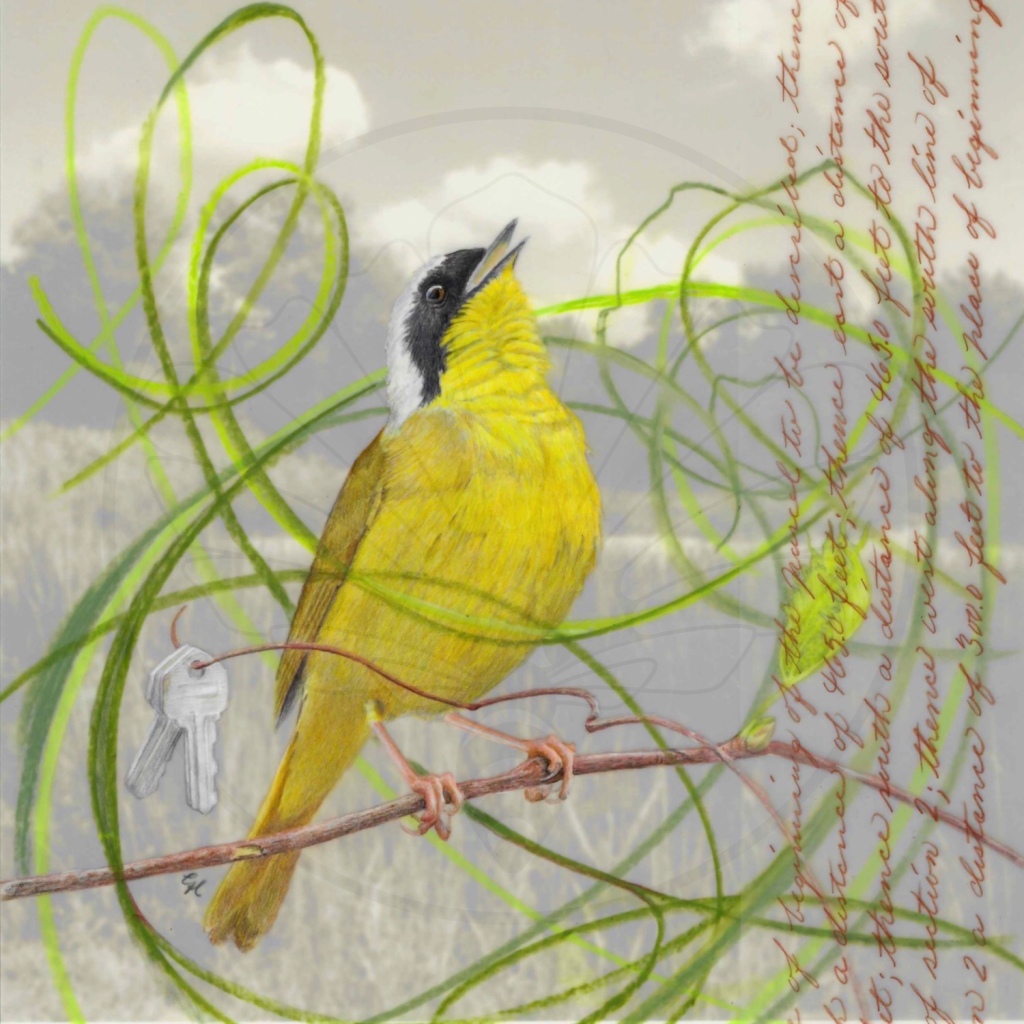
Each piece in this new project will incorporate historic documents about a geographic location, feature, or region (such as the Kankakee River or the Indiana Dunes). The documents record changes in Northwest Indiana between the years of settlement (roughly 1830) to the first successes of the conservation movement in the early twentieth century (roughly 1925). I’m eagerly searching out diary entries, land survey notes, stories, poems and articles.

“Enter a Wet Prairie” explores the historic loss of habitat for grassland birds like the Dickcissel. The background photo is the restored prairie at Reynolds Creek Game Bird Area, and the historical document is the land survey note matching that location. Restoration efforts in Porter County are reclaiming land for tallgrass prairie, and there is hope that we can continue to enjoy grassland plants and animals into the future.

Thanks for making it to the end!. As a reward, please claim your free downloadable prairie kaleidoscope coloring page!

Drama in the Dunes

Recently, my friend Kristina and I met at the Great Marsh Trail in the Indiana Dunes National Park for nature journaling. I expected sunshine, mosquitos, lots of birds, and overgrown trails. I didn’t expect small dramas to unfold as we worked. Nature is teaching me to pay more attention.

It can be hard to settle down to observing and sketching. It turns out you can’t bird, and photograph, and sketch all the same time! And then you want a better look at a swallow, or are distracted by sandhill cranes honking in the distance. Somehow we managed to settle in. A cooperative Common Yellowthroat returned several times to sing from a favorite perch. Kristina captured his confident posture and made a beautiful sketch of his surroundings (see her wonderful avifauna paintings at KristinaKnowski.com)
Capturing a Common Yellowthroat in action. Copyright Kristina Knowski.

I had a long look at Canada Geese through my binoculars and enjoyed sketching them. They were rolling their heads at one another, and I wondered what they were communicating.

Birds are constantly in motion. Copyright Christine Hubbell.

Clouds moved in and the wind picked up. We headed east, hoping to find a viewpoint into the next marsh and maybe a peek at the cranes. We passed a turtle and a frog on the trail. What did they think of each other?

A storybook encounter? This Northern Leopard Frog seemed to be making the same journey as the turtle.

On our way out Kristina noticed a noisy confrontation unfolding just off the road. A variety of bird species were agitated, but it was the Oriole making the most racket. He was harassing a pair of red-shouldered hawks. I saw the female come in once, and we spotted a feisty robin approach, but otherwise the Oriole was on his own. We didn’t stay to see who won, but I left with loads of questions.

A dramatic encounter recreated from memory and photos, enriched by curiosity. Copyright Christine Hubbell.

Observation opens our curiosity in ways that can only be satisfied with more observation. Were the frog and turtle “together” on the trail? Or were they coincidentally moving from the wet marsh to drier land? Maybe we happened on a favored crossing zone. Had the hawks eaten recently? (They seemed disinterested in the kerfuffle they were creating.) How often do the hawks visit that spot?

Unanswered questions, excellent company, and a beautiful day are now woven into the pages of my journal, and I’m grateful for the ability to be aware and present in nature. I’m sure I’ll enjoy this rich set of memories during the darker and quieter days of winter.

The Creative Season

For me, March is the opening of the creative season. As the studio fills with new ideas, the world pivots from darkness to light, from the quiet waiting of Winter to full-throated Spring. It’s a good time for reflection. My artwork continues to evolve, but with familiar components—a love of beauty, a prayer for conservation, a hope of connection.

Eastern Bluebirds in progress, on a cake plate with peach and lottery ticket. Colored pencil on drafting film.

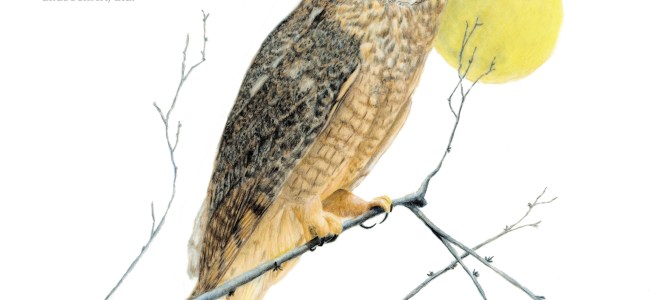
My recent colored pencil paintings capture imaginary wildlife encounters in human spaces, blending storytelling with natural science illustration. They place birds in human-made settings, echoing the role we play in shaping and controlling wildlife habitat. I’m never sure where the whimsy comes from, but I need that playfulness to round out my compositions.

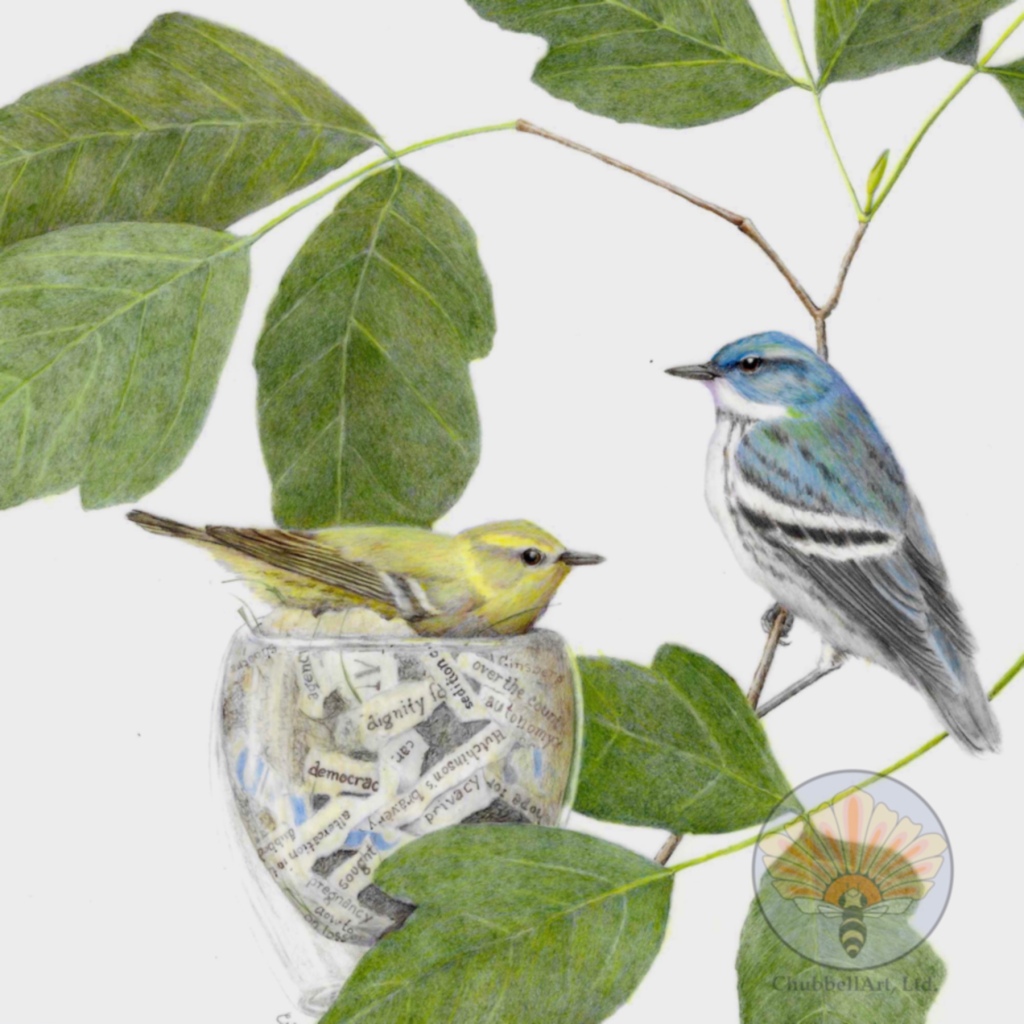
I created “Folly” in response to seeing nesting Cerulean Warblers at a birding festival. Through the scope, we watched the male and female tending their nest, tucked in the crook of a branch about 20 feet directly above a busy trail. It reminded me that birds have a precarious life, often struggling to succeed in challenging conditions.

“Folly.” Colored pencil on drafting film. Selected for the Hoosier Women Artists Exhibition 2023, it’s on display for a year at the Indiana State House.

I illustrated the nest as a glass cup filled with the news of the day, a fragile and potentially disastrous choice. I surrounded them with Poison Ivy, which has a dual nature. It’s terrible for us, but beneficial for birds. I titled this piece “Folly” because foolishness is a good place to begin any journey. In foolishness we find the confidence to trust we’ll find what we need along the way.

I don’t know where my muse is taking me this year, but if it’s a Fool’s Journey, it’s bound to be interesting.

Year of the (Bunny) Rabbit

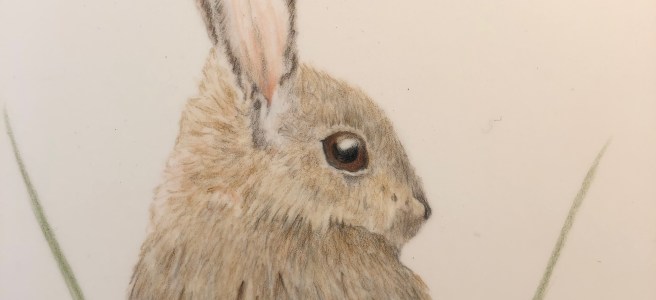
Baby bunnies are all ears and bellies. To celebrate the Year of the Rabbit, I’ve just completed three eastern cottontail illustrations based on my photos. May is a reliable time to watch for these tiny foragers, who will taste almost everything in the garden. We were entertained by their zippiness, which I suppose kept them from being taken by hawks and owls. We weren’t so fond of their appetites. They especially loved my Firewitch Dianthus, and I hardly got to see it bloom once the bunnies arrived. I’ve illustrated them with phlox, another of their favorites. Which bunny would you choose? Love all three? Check out my Spoonflower shop for these cute little guys in repeat!

Baby bunny illustrations

Originals and prints will be available soon. Please use the contact page if you’re interested.

Bird Sketching – Life in Progress

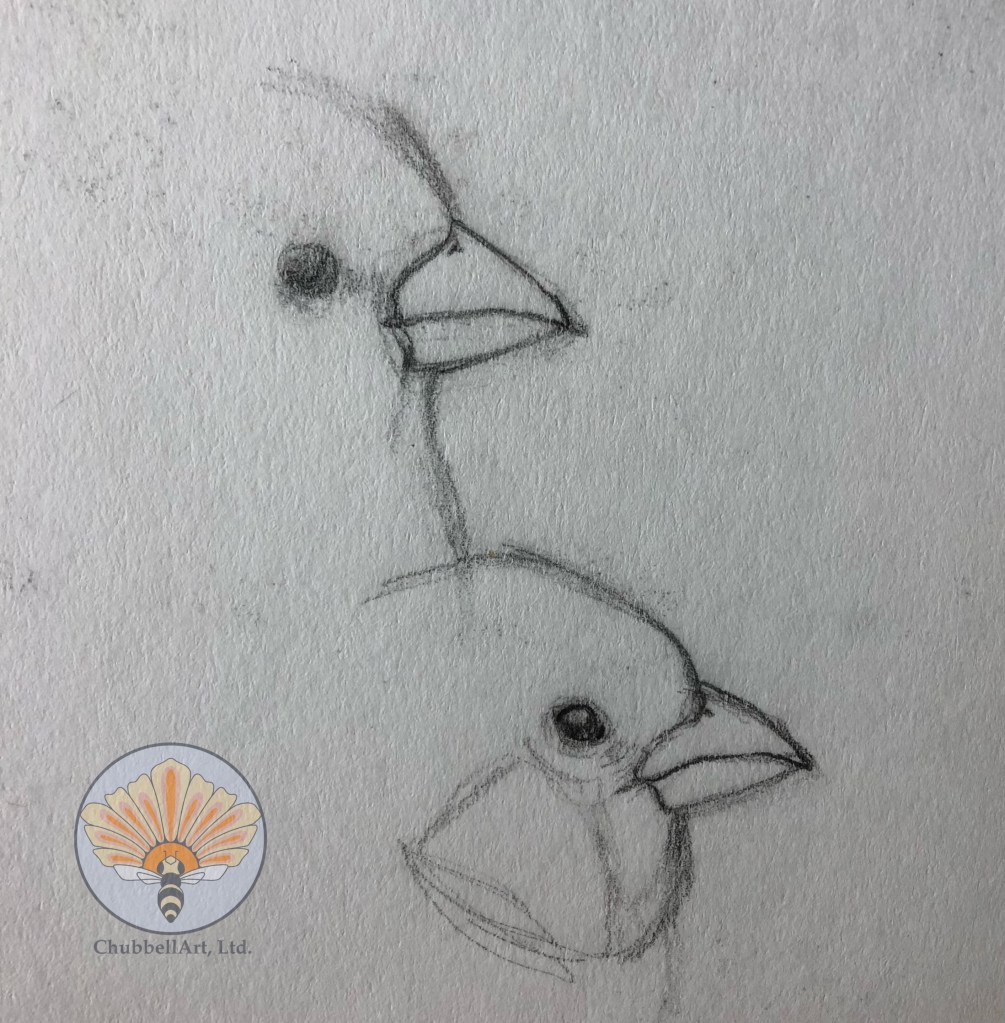
When the weather was too poor this winter for outdoor sketching, I set up my drawing supplies on the porch, plugged in the space heater, and worked on sketching birds from life. I found the chickadees and finches very challenging. Why couldn’t I observe some sleeping ducks on a pond instead? But the most convenient, numerous collection of live birds was right there on the other side of my window.

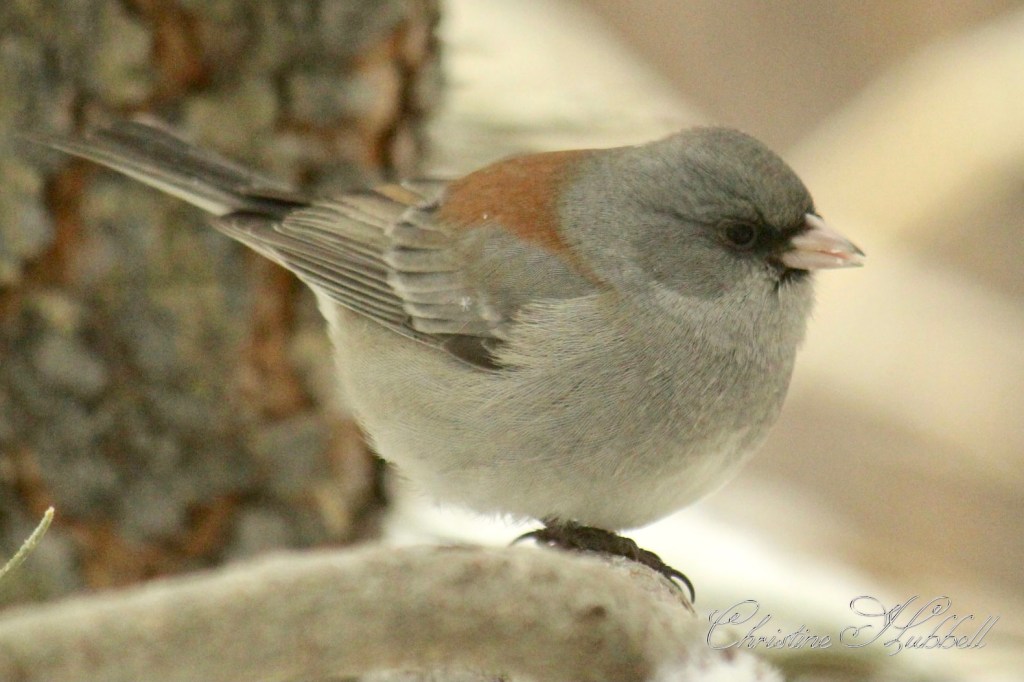
February feeder birds sketches, mostly Juncos and House Finches.

So I worked, and struggled, and wondered how anyone completes an actual sketch of a bird in the field. I started with basic gestures, borrowing ideas from books, blogs, and videos. I knew I could draw from photos, but I wanted to be able to complete a finished-looking sketch during my sketching session. Then I found a bit of helpful advice: build your memory.

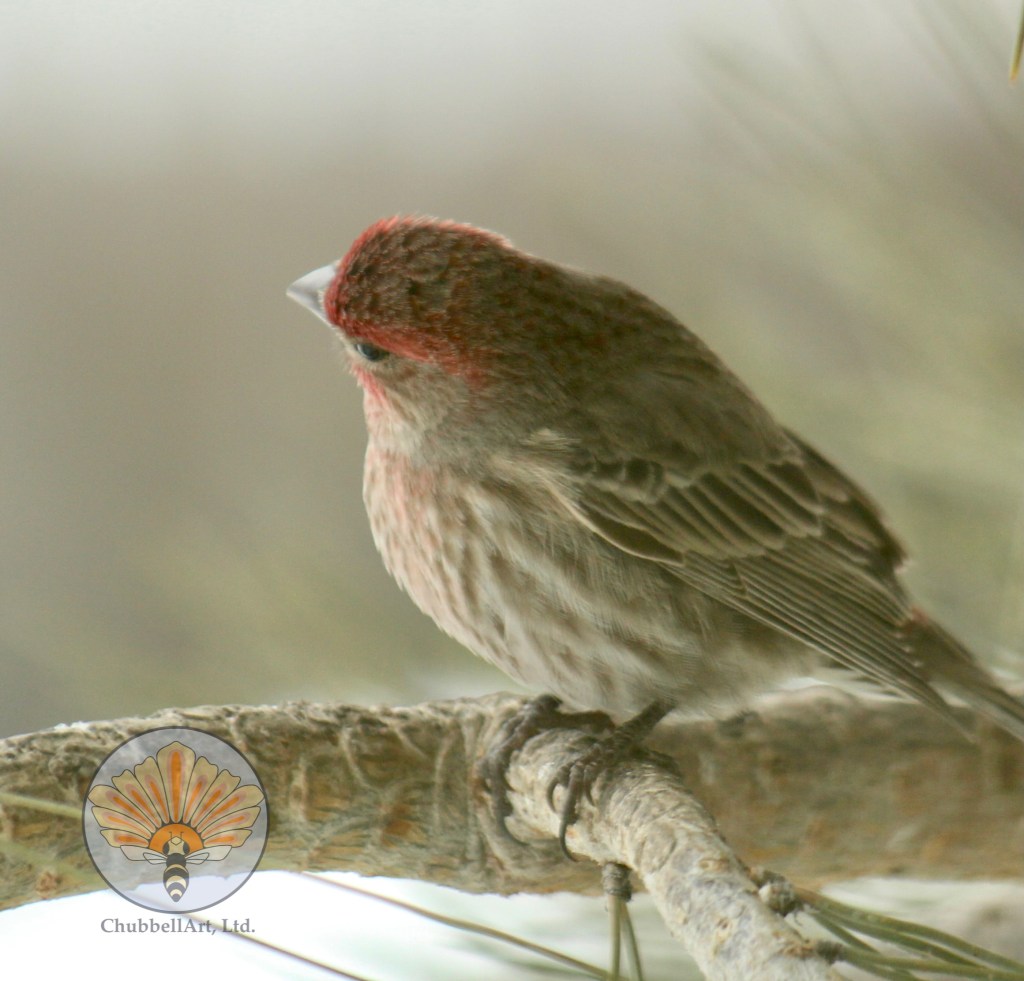
Always on the lookout, and constantly on the move: House Finch in the Ponderosa Pine. You only get a moment to capture something about a live bird.

Hmmm, I thought. I guess I should memorize the shape of that finch bill. But no, it’s not like school. I couldn’t memorize a set of visual facts. Putting the right information into memory requires repeated drawing from life, which enhances both my observation and drawing skills.

The more we look, the better we understand. A second observation of a House Finch bill at bottom right.

When I realized that the practice itself would build my memory and make sketching faster, I stopped struggling. Drawing from life is recommended by successful bird artists like John Busby and William T. Cooper. Busby was a British wildlife artist, educator, author, and a founding member of the Society of Wildlife Artists. He described bird sketching as a long-term practice:

Encounters with wild birds are usually measured in split-seconds, and one is rarely given another chance to react…It does take time to learn to draw quickly and a good memory and a high-speed response is something to cultivate…there is much that can be done to sharpen observation and fix events in your memory.

John Busby, Drawing Birds Timber Press, Second Ed 2006

William T. Cooper was a prolific Australian bird illustrator who worked from life. Here he explains the experience of developing a working memory of your subject:

Drawing from life is very important: it allows much more information to penetrate the mind than when copying from a photograph. This information enters the subconscious and will be drawn upon when required some time in the future.

William T. Cooper, Capturing the Essence, Techniques for Bird Artists Yale University Press 2011

He makes it sound almost magical. And I’m discovering an ease to developing these skills when I stop struggling and let the process unfold. I’m working on more responsive gestures while I let bird behavior and proportions seep into my brain. As I work more quickly, that thinking, left brain settles down, and I also feel more present.

Migratory birds add color and excitement to the feeding stations.

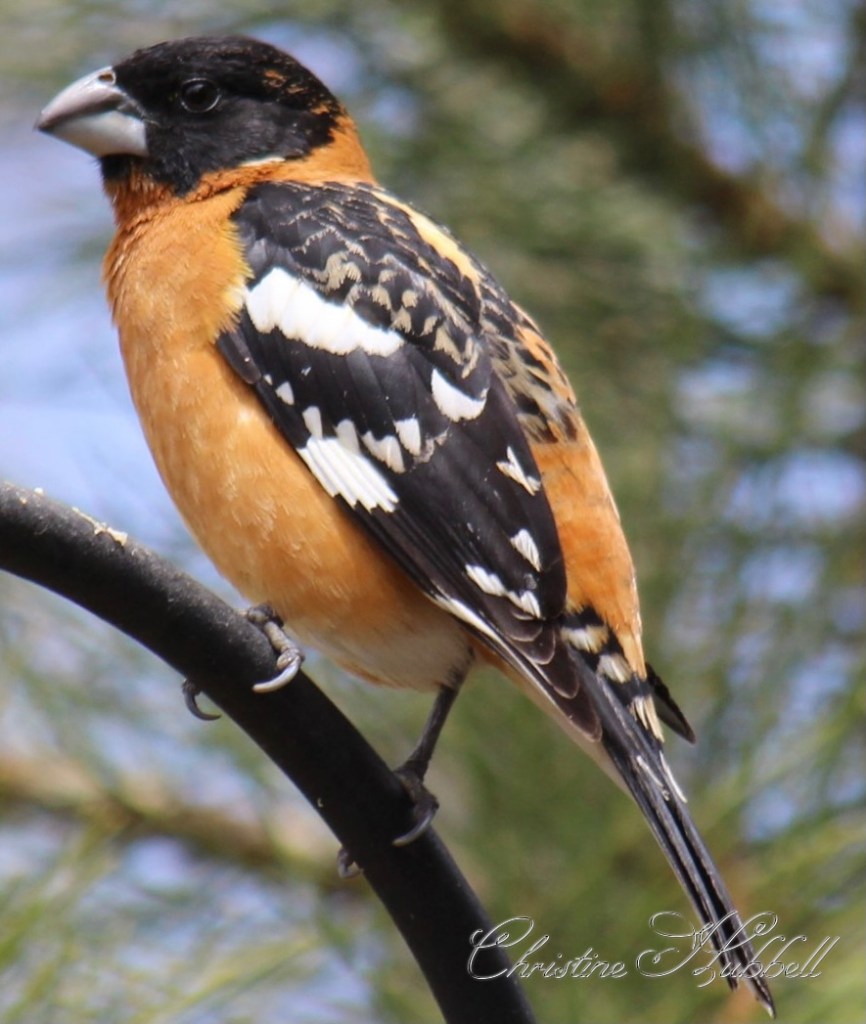
It’s May now, and migration season in Colorado is in high gear. Western Tanager, Bullock’s Oriole, and Black-headed Grosbeak are competing with a small, noisy flock of Pine Siskin for seeds and oranges. What a delight to sit here for an hour working with the birds, gently encoding all that behavior, noise, and color into memory.

A Passion for Birds

It’s late winter, just around the corner from Valentine’s Day. It’s the perfect time to reflect on the many loves in my life, including my passion for birds, art, and science.

These three loves coalesce in the practice of natural science illustration, often referred to as “art in the service of science.” But science can also serve beauty. Accurate, detailed drawings can capture our imaginations and hearts in a way that leads us to curiosity, delight, and a desire to protect.

In the end we will conserve only what we love, we will love only what we understand, and we will understand only what we are taught.

Baba Dioum
Untitled watercolor painting of a european goldfinch, campanula flower and dutch poppy by scientist and artist Maria Sibylla Merian, 1600s
Maria Sibylla Merian 1705

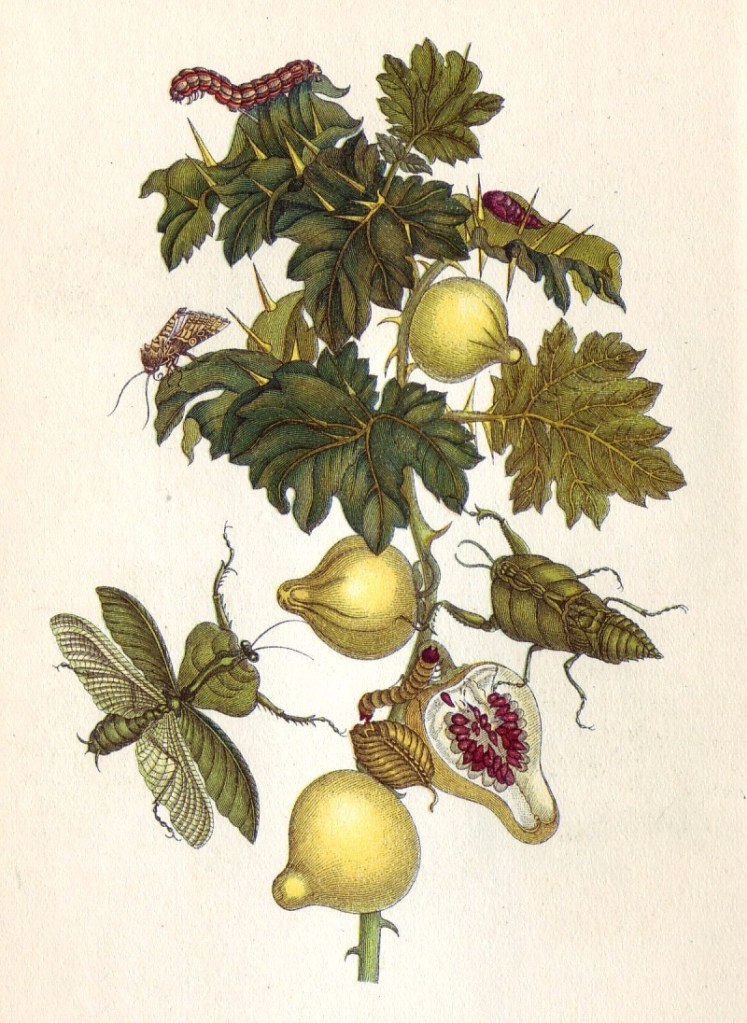
In 1699, Maria Sibylla Merian left her home in Amsterdam and traveled with her daughter to Surinam where she continued her work as an entomologist and natural science illustrator. Sibylla Merian was an entomologist, illustrator, and publisher. Her work redefined what was known about metamorphosis. You can see in her engravings and paintings how lavishly she loved what she encountered.

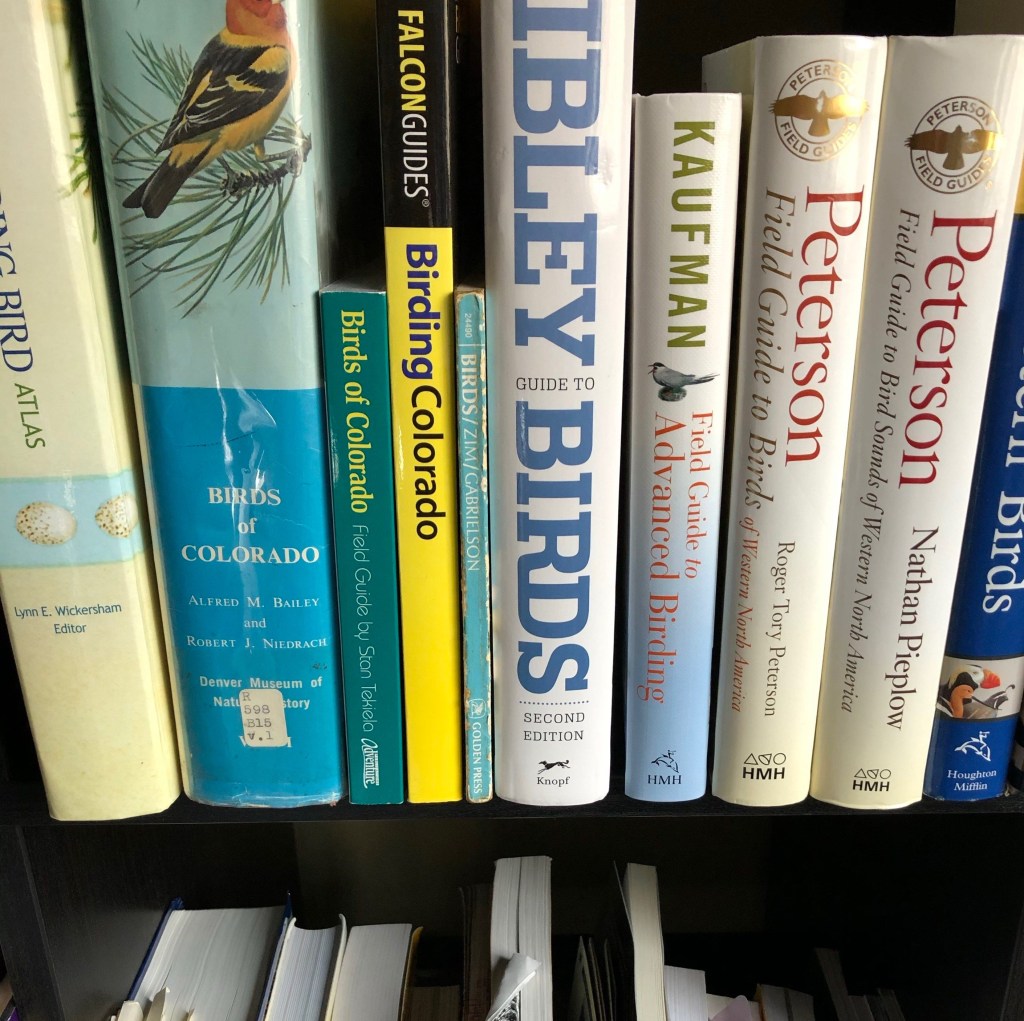
Today we encounter natural science illustration almost everywhere we look. If you’re a birder, you probably have at least one field guide on your shelf. We rely on the adept illustrations of each species to help us identify birds (and other life) in the field. But we may not be aware of the thousands of hours of research, field observation, and craft needed to produce these complex works. That’s what natural science illustrators excel at: simplifying complex scientific ideas with rigorous accuracy. This is a job for people with passion.

Photograph of a bookshelf showing a handful of bird field guides

At the Denver Botanic Gardens School of Botanical Art and Illustration, I learned how to be rigorous in researching and understanding the plant species I illustrated. When I decided to concentrate on illustrating birds, I wanted to apply that same rigor, but with a shift in focus. I wanted to render birds as accurately as possible for the sheer joy of it. My hope is that the delight and joy of rendering the beauty of birds comes through in the lush details and colors, the soft textures, and even the scaly feet (always challenging for me to see properly, and endlessly fascinating). My bird studies are just beginning.

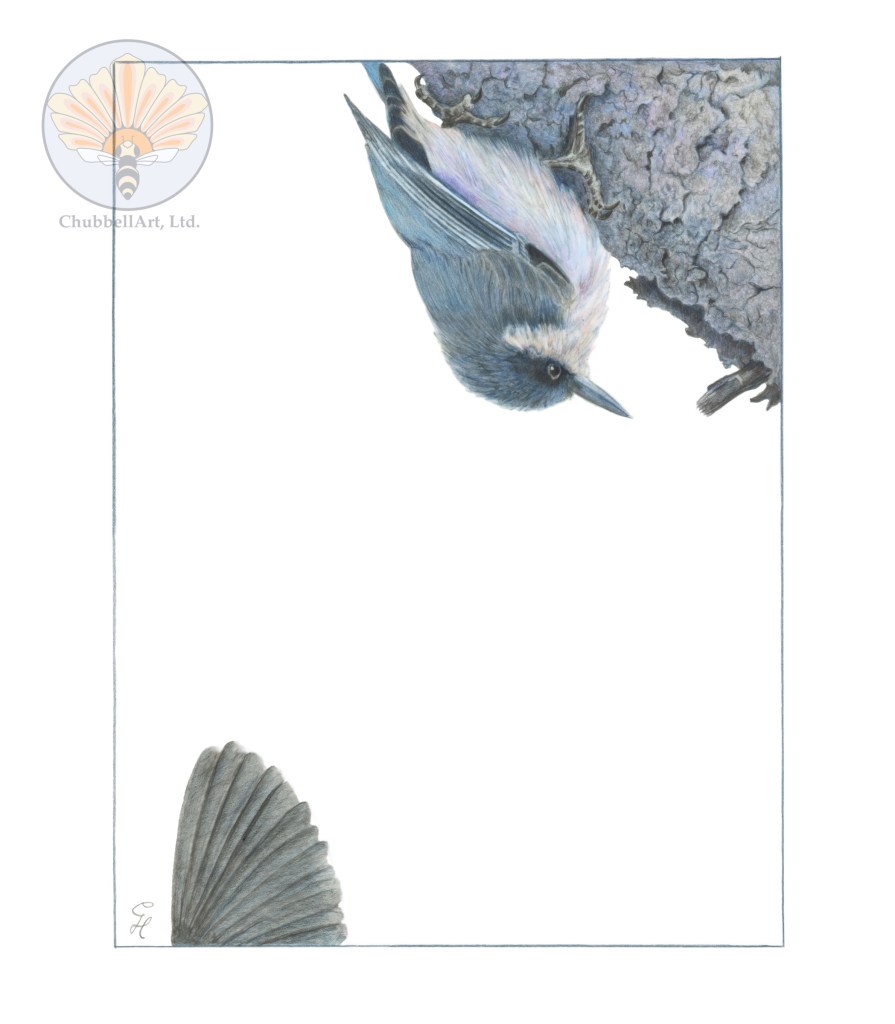
Color pencil illustration of a pygmy nuthatch upside down on a large tree branch
Pygmy Nuthatch / 2020
Copyright Christine Hubbell

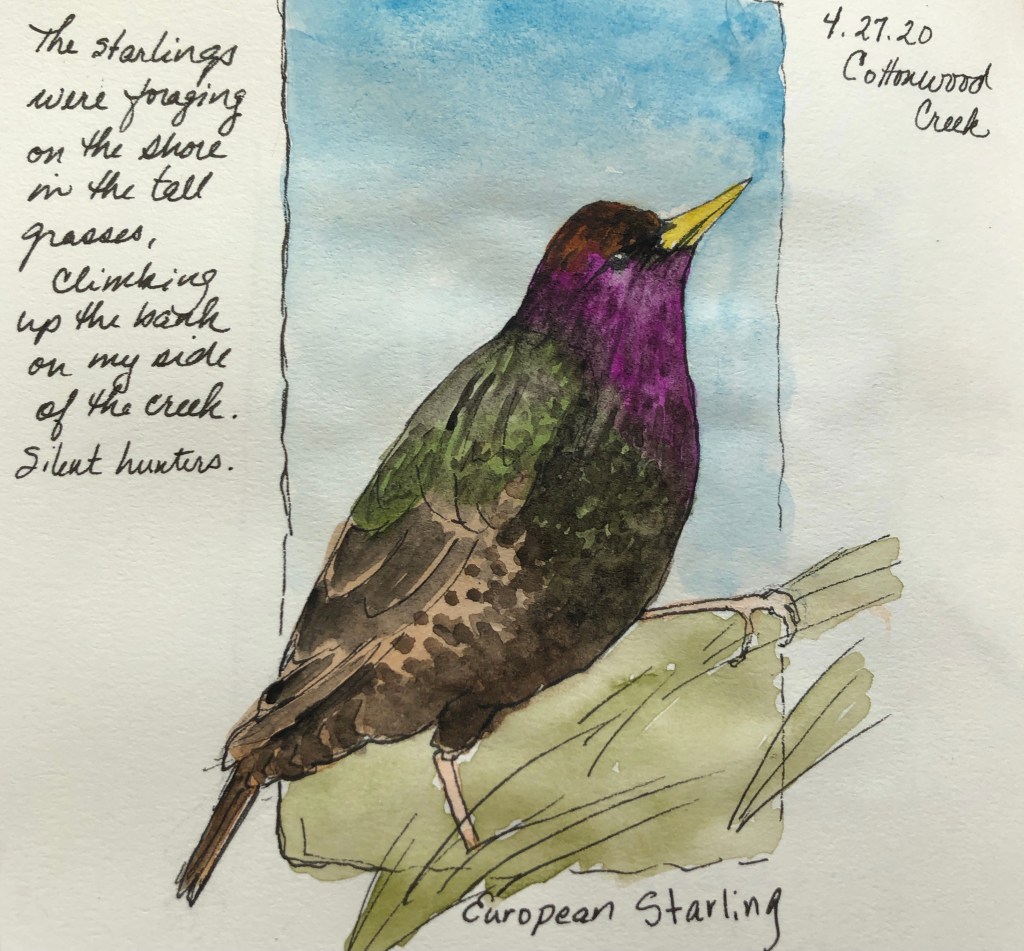
Drawing and illustrating birds is a highly rewarding, challenging practice. You can start at any age, and with the basic skills of handwriting. A great place to start is in your nature journal. This is where you record what you see, hear, and experience. And you don’t need big outdoor spaces. A porch, patio, or back yard will do. Record your observations over time and you’ll also have a rich historical record of your experiences.

Photograph of a page from a nature journal that shows a color drawing of a european starling; dated April 27, 2020. Includes some text in the margin “The starlings were foraging on the shore in the tall grasses, climbing up the bank on my side of the creek. Silent hunters.

Some of my favorite nature journaling resources are by John Muir Laws. His books on journaling, drawing birds, and teaching are carefully written, easy to follow, and enormously helpful. David Allen Sibley has wonderful process and drawing videos available from his website as well.

For all things bird, explore the amazing artists and educators at the Cornell Lab of Ornithology Bird Academy. They offer both real-time and recorded nature journaling workshops as part of their extensive series of classes and workshops.

Hermit Thrush / 2021
Copyright Christine Hubbell

There are so many reasons to love the artistry that allows us to understand birds, and so many reasons to love birds through making art. When we draw birds as a way of studying them, our minds shift to observing with intention. We learn to see aspects of birds that we would otherwise miss.


I’ve posted the following for anyone who’d like more time to draw along with the images in my Aiken Audubon nature art presentation.

If you’d like to watch the 44 minute presentation, you can see it on the Aiken Audubon YouTube Channel.

Transforming Winter

Sunshine on Cottonwood Creek

I used to hate winter, especially the month of November. Here in Colorado, fall leaves hit peak color toward the end of October. We’ve had our first or second snow. The winds pick up, then die off, and November sets in. November days are stark, short, and ugly. At least, that’s how I used to think of them.

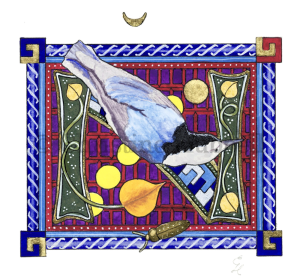
I believe that making and viewing art is transformative. My attitude toward November took a 180 degree turn when I spent part of the month designing and painting a small illumination based on the letter “N.” At first it had nothing to do with November. Just nuthatches. I’d been seeing them in my yard and went looking for them down at the creek.

Red-breasted Nuthatch

At the creek I met a lovely fellow birder who knew exactly which trees the nuthatches were using. Cathy pointed me toward a couple of hollow Cottonwood branches and there they were. We heard them, too. Nuthatches have a squeaky balloon chatter that’s unmistakable once you catch on.

White-breasted Nuthatch in flight

The more time I spent outdoors looking for nuthatches, the more I noticed that the days were not just dry and short, they were also warm and soft and beautiful. Birds sang everywhere. The water in the creek had a particularly bright sheen from the low, south-driven sun. I couldn’t possibly be warming up to November, could I?

But there it was, creeping into my design for the illumination. The winter sun moving across the sky. The nuthatch prying at the bark of a Cottonwood amid scattered leaves. A sense of stillness at the center of a season in transition. This was my early winter meditation, and it transformed how I felt about those bleak November days.

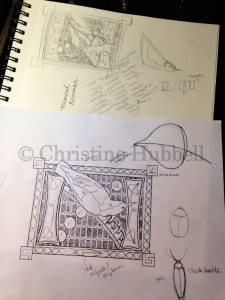
Illuminated N Sketches

I learned illumination techniques from Renee Jorgenson, who is a wonderful artist, teacher, and master calligrapher. The process starts with a small design, no more than 4 inches square. Every element is carefully planned, from the letter form to the motifs and background patterns. Gold leaf goes down first, then flat color applied with gouache. Black ink and white or pastel details make the colors pop and add visual interest. When it’s successful, you get that sense of a medieval manuscript illuminated with jewel-toned colors. A mini stained glass window on paper.

Illuminated N

I scanned this piece and used it for Christmas cards, but its legacy is that I will always associate it with enjoying the month of November. I hope it speaks to you, too, because there are more tough winter months coming. February can be dark and cold. But “F” is also for flicker, and I think we’re ready for it.

Basic Black

Pencil cartoon

They say the little black dress never goes out of style. It’s simple and can anchor an entire wardrobe. Maybe that’s why I love working in graphite. When I’m overwhelmed with juggling color, it feels good to go back to the basics. Composition, value, and shape. Graphite is the little black dress of my art wardrobe.

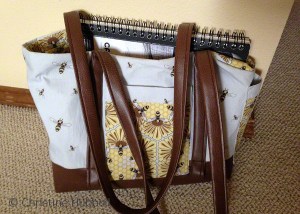
Some of my favorite drawings are smudgy graphite sketches. Smudgy is good because it adds instant mid tones. I like to work on toned paper, too, but lately I’ve been heading out with nothing more exciting than a 2B pencil, an eraser, and my Canson sketch pad – the perfect “go anywhere” medium. I’ll confess to a little color excitement here. I made this bag from fabric I designed last year. It’s the perfect companion for sketching trips to the Denver Museum of Nature and Science.

Purse and sketchbook

We often get an audience when we’re working in front of the natural history dioramas. This trip, I showed one summer camper how easy it is to pick out shapes with a kneaded eraser and smudge them back in again when I don’t like the results. “It’s like magic!” she said. I agree – a happy kind of magic where drawing is more like painting.

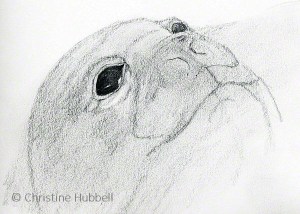
Seal face

After scribbling in some tone and smudging it with my finger (which is not exactly archival, but hey, it’s just sketching), I lay in a few shapes and pull out highlights, then work in the details. It’s relaxing to sit very still and look carefully, rechecking proportions and reshaping something to be more accurate.

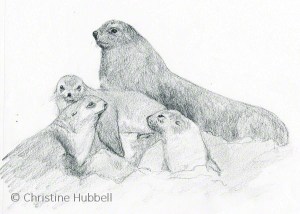
Seal family

So bloom on, tawdry flowers of summer. I know you’re calling to me too, but for now I’ll wear basic black. And shades of grey.


Serendipity

Recently I needed reference photos of mice. I’ve snapped bighorn sheep, pocket gophers, praying mantis, flies, fish and salamanders. Rabbits by the bucket. Squirrels by the tub. Not one mouse.

Be careful what you wish for.

Hubbell031

My husband and I were having dinner on our porch when I heard him say “what the heck is that?!?” He’d spotted a mouse gathering spilled thistle at the base of the bird feeder. We spent the next few nights photographing and counting mice. We may have to think about a relocation plan. Or at least a little tightening up around the foundations before fall.

But how nice to have the universe respond in a moment of need. In fact, it’s been a season of serendipity. When I attended the annual conference of the Guild of Natural Science Illustrators in July, I lucked into the perfect experiences.

I learned about advocating for tiny members of our ecosystem in a talk by Marla Coppolino. Her presentation gave me ideas for raising awareness of Colorado native bees and pollinators. I took home an incredible piece of artwork sculpted by Karen Johnson. I want to wear it everywhere!

Linda Feltner taught a workshop using the principles of notan – creating a balance of lights and darks, warms and cools in a composition. I’ve taken a bird workshop from Linda, and love her teaching style and her depth of knowledge about painting the natural world. Her GNSI workshop was an eye-opening exploration of composition for natural science subjects. I gained an understanding of how to situate the birds and insects I want to illustrate in their environment. I can’t wait to get started.

Hubbell032

Leon Loughridge (Dry Creek Art Press) also demonstrated notan principles in his field sketching workshop. Leon showed us how to see the lights, darks, warms and cools in the landscape and to shape them for good balance. Something else I’m anxious to practice.

Recently, I needed some raven photographs. There are ravens just up the hill, but they are cagier than mice. I may need more than serendipity.

Hubbell036


June in the Studio

Hubbell029

Welcome to the inaugural post of chubbellart.com. This month I hope to finish the latest in my series of bird portraits. These blue jays are done in mixed media, but primarily water color. I’m building up layers of grainy colored pencil and water color in the background. I’ve used water color pencils as well. I’m working on Arches 140# hot press, and it seems to be holding up to all the scrubbing and lifting I’ve been torturing it with.

Hubbell028

My long journey to learn the craft of children’s book writing and illustrating continues. I’m participating in the SCBWI Carolinas Picture Book Dummy Challenge. It is truly challenging. After working on character development, setting, and composition, we’re finalizing dummy sketches and creating finished artwork. My story is about a cat named Noodles who must tame the magic sock in order to get his heart’s desire. I’ve got Noodles taped to the back of my studio door. I’m using the cats as models when they can be bothered to pose. I’ve got a week to finish the dummy sketches, a month to get the final art ready, and my primary goal is to not embarrass myself when I submit everything at the end. Assuming, of course, that I’ve checked in at all stages of the challenge and finish on time. We’ll see how it goes!