At the Tail End of Quiet

I understand why we use the beginning of the year to make a fresh start. The holidays are behind us with their noisy chaos and overindulgence. Closets and arteries need cleansing. And even at the end of January, the calendar still has a compelling sense of possibility.

But I don’t want to race ahead. I’ll be very grateful for spring’s renewing energy. I just want to stop a while at the edge of winter and take one last look around.

Magpies on a snowy trail
Magpie feathers are structurally blue in sunlight

What I see are the dusty browns and gray-greens of faded plant material providing camouflage for the birds. That’s Colorado, of course. Fifty thousand shades of tan! Look closer and you notice that song birds and other critters are surviving on grass seed and the fruits that have persisted into winter. So there’s life in this season if you know where to look.
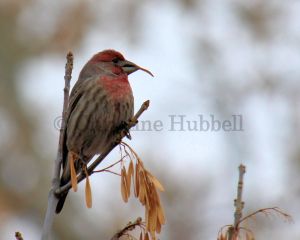
House finch on a branch eating ash seed
A house finch gleans seeds from an ash tree

When I decided to illustrate the common hop plant, I was thinking about the plump green flowers I’d seen in early September.
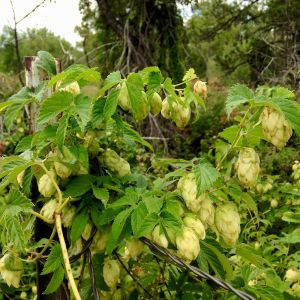
Hop flowers and hop leaves on a barbed wire fence
Fresh hop flowers

But by December, the plants had long since dried. Botanical illustrators often reconstruct plants from herbarium specimens, which are specially prepared by trained collectors from living plant material. They are works of art in their own right, arranged to show the flowers and growth pattern of the plant. They bring the plants back to life.

Without a herbarium specimen, it was a bit of a stretch to think I could get the information I needed from a handful of dried hops. I got as far as soaking some curled leaves in water, unfurling them to get a look at their shape, and making a few sketches. The flowers were another problem. Hop flowers open and curl as they dry, so I couldn’t confidently use them to simulate fresh flowers.
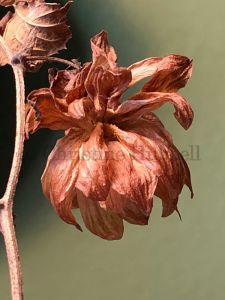
A dried hop flower

What I did learn from the dried hop flowers was just how interesting they are in their own right. There’s something soothing about their monochromatic warmth. The bracts and bracteoles swirl around the strig, reminding me of a paper chandelier or a folk dancer’s skirt adorned with ribbons.

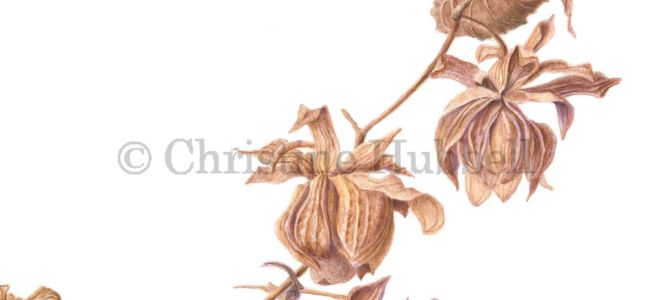
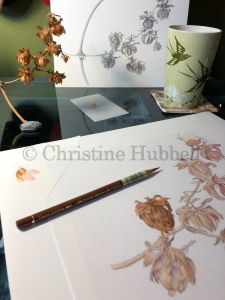
An illustration of dried hop flowers
Detail of dried hops. See the full illustration in the gallery.

There are many things pulling me forward as January drifts into February. In a few weeks I’ll be hosting my first ever open studio sale. Artwork needs to be matted, packaged and priced if it’s going to find a new home. I could jump into a swirl of activity.

Or I could ease into my studio while juncos forage for seeds in last year’s monarda. I could think about all the winter birds making a living among the last of the berries, and I could be grateful for a handful of dried hops on my drawing table.
Transforming Winter

Sunshine on Cottonwood Creek

I used to hate winter, especially the month of November. Here in Colorado, fall leaves hit peak color toward the end of October. We’ve had our first or second snow. The winds pick up, then die off, and November sets in. November days are stark, short, and ugly. At least, that’s how I used to think of them.

I believe that making and viewing art is transformative. My attitude toward November took a 180 degree turn when I spent part of the month designing and painting a small illumination based on the letter “N.” At first it had nothing to do with November. Just nuthatches. I’d been seeing them in my yard and went looking for them down at the creek.

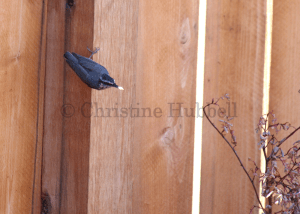
Red-breasted Nuthatch

At the creek I met a lovely fellow birder who knew exactly which trees the nuthatches were using. Cathy pointed me toward a couple of hollow Cottonwood branches and there they were. We heard them, too. Nuthatches have a squeaky balloon chatter that’s unmistakable once you catch on.

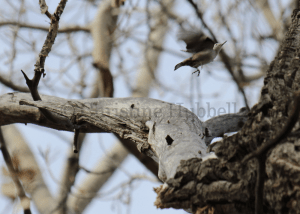
White-breasted Nuthatch in flight

The more time I spent outdoors looking for nuthatches, the more I noticed that the days were not just dry and short, they were also warm and soft and beautiful. Birds sang everywhere. The water in the creek had a particularly bright sheen from the low, south-driven sun. I couldn’t possibly be warming up to November, could I?

But there it was, creeping into my design for the illumination. The winter sun moving across the sky. The nuthatch prying at the bark of a Cottonwood amid scattered leaves. A sense of stillness at the center of a season in transition. This was my early winter meditation, and it transformed how I felt about those bleak November days.

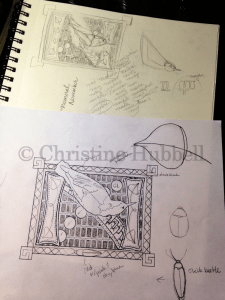
Illuminated N Sketches

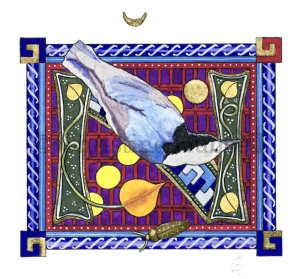
I learned illumination techniques from Renee Jorgenson, who is a wonderful artist, teacher, and master calligrapher. The process starts with a small design, no more than 4 inches square. Every element is carefully planned, from the letter form to the motifs and background patterns. Gold leaf goes down first, then flat color applied with gouache. Black ink and white or pastel details make the colors pop and add visual interest. When it’s successful, you get that sense of a medieval manuscript illuminated with jewel-toned colors. A mini stained glass window on paper.

Illuminated N

I scanned this piece and used it for Christmas cards, but its legacy is that I will always associate it with enjoying the month of November. I hope it speaks to you, too, because there are more tough winter months coming. February can be dark and cold. But “F” is also for flicker, and I think we’re ready for it.

Basic Black

Pencil cartoon

They say the little black dress never goes out of style. It’s simple and can anchor an entire wardrobe. Maybe that’s why I love working in graphite. When I’m overwhelmed with juggling color, it feels good to go back to the basics. Composition, value, and shape. Graphite is the little black dress of my art wardrobe.

Some of my favorite drawings are smudgy graphite sketches. Smudgy is good because it adds instant mid tones. I like to work on toned paper, too, but lately I’ve been heading out with nothing more exciting than a 2B pencil, an eraser, and my Canson sketch pad – the perfect “go anywhere” medium. I’ll confess to a little color excitement here. I made this bag from fabric I designed last year. It’s the perfect companion for sketching trips to the Denver Museum of Nature and Science.

Purse and sketchbook

We often get an audience when we’re working in front of the natural history dioramas. This trip, I showed one summer camper how easy it is to pick out shapes with a kneaded eraser and smudge them back in again when I don’t like the results. “It’s like magic!” she said. I agree – a happy kind of magic where drawing is more like painting.

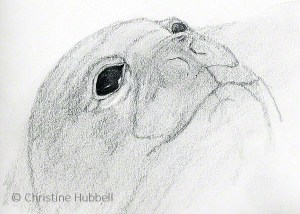
Seal face

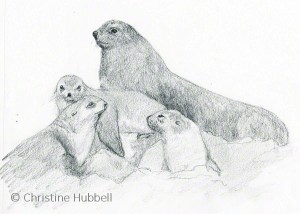
After scribbling in some tone and smudging it with my finger (which is not exactly archival, but hey, it’s just sketching), I lay in a few shapes and pull out highlights, then work in the details. It’s relaxing to sit very still and look carefully, rechecking proportions and reshaping something to be more accurate.

Seal family

So bloom on, tawdry flowers of summer. I know you’re calling to me too, but for now I’ll wear basic black. And shades of grey.